
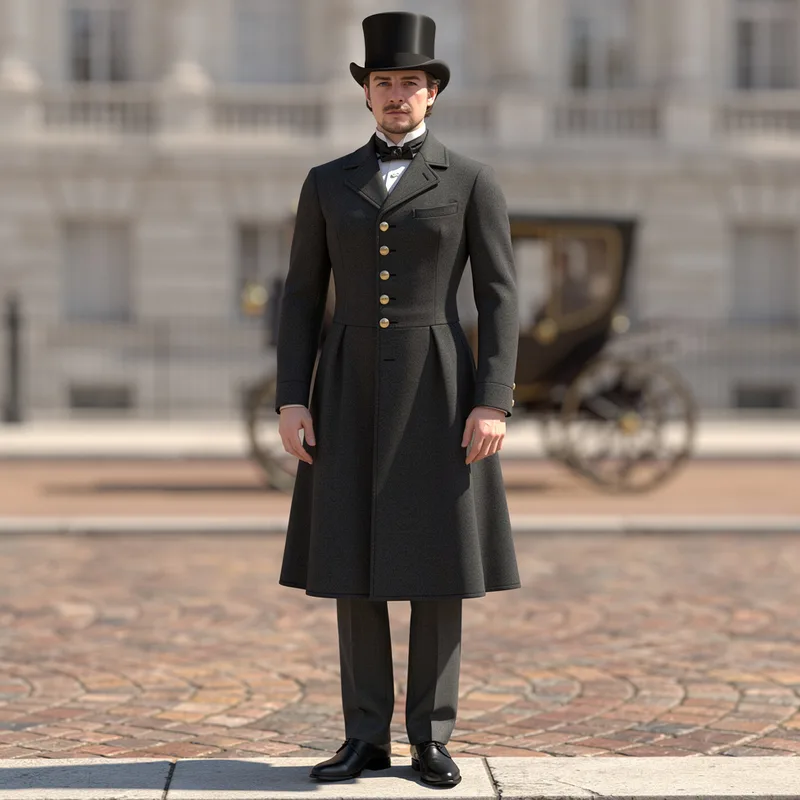
frock coat
 2
9.9
2
9.9

- noun
- /frɒk koʊt/
- Archaic
- The three of us wore black frock coats buttoned to our necks, black top hats, and gloves.
- a black frock coat
Examples
-
Gilkes, never far from anything happening at the school, watched each game dressed in his frock coat and top hat.
Fiction book (1999) -
He attended the formal dinner wearing a long, elegant frock coat that highlighted his distinguished appearance.
-
There he stood in his black frock coat, top hat in his hands, sober and silent.
Fiction book (1998) -
The people there were all well-dressed men in business suits, top hats, and frock coats.
Fiction book (1992) -
Mr. Grummage was dressed in a black frock coat with a stovepipe hat that added to his considerable height.
Fiction book (1997) -
The distinguished-looking gentleman in the well-cut frock coat was keeping it at bay outside the wrought-iron gate.
Fiction book (1994) -
Silent, pale men with long sidelocks of hair, wearing black frock coats and fur hats, passed her on their way to the synagogue.
Fiction book (1993) -
His black frock coat, plaid vest, and baggy trousers spoke of money and quality, but were wrinkled and creased.
Fiction book (1992) -
Octave Marilly wrote in La Semaine Politique in 1857, "The black frock coat and the white cravat render men equal..."
Academic text (1997) -
The man walked confidently into the ballroom, his tailored frock coat contrasting sharply with the vibrant decorations.
Synonyms
 957
1.0
957
1.0
A warm piece of clothing with sleeves worn outside

A formal long coat for men with two rows of buttons popular in the 19th century
How Formal

Surface Forms
Morphology
The meaning is directly compositional: 'frock' (a long, loose garment) modifies 'coat' (an outer garment), so a B1 learner who knows both words can infer this denotes a coat with frock-like, skirted features (knee-length). This noun–noun type description is a common, predictable formation across languages, so the expression is transparently derived from its parts even if the historical style is unfamiliar.
Etymology
Frock coat may come from the older word frock, meaning a 'gown' or loose, dress-like garment, combined with coat. Because these men's coats had long, skirt-like parts like a dress, people called them frock coats, so the name now means the formal knee-length coat worn in the 19th century.