

to fan
 7
1.0
7
1.0

- verb
- /fæn/
- Wenatchee police Sgt. John Kruse says gusty winds could fan the flames of dozens of blazes.
Examples
-
On a hot day, I like to fan myself to feel cooler.
-
I had to put more paper on the fire and fan it with the cookie sheet before it flared up.
Fiction book (1991) -
Sore as I was, I tried to fan with my left arm.
Fiction book (1998) -
You can fan me while I make the salad dressing.
-
We had to open one window, and one guy used cardboard to fan the smoke outside.
Fiction book (1997) -
When the smoke curls from his nose, Yolanda fans it away with her hand.
Fiction book (1994) -
He can fetch water and props and fan us when it's hot.
-
She used a magazine to fan the flames and help the fire grow.
-
To make the room more comfortable, he decided to fan the air towards himself.
Synonyms
 711
1.0
711
1.0
To move air forcefully using your mouth, wind, or a fan
Idioms

Phrasal Verbs

Compounds











- Informal
3
3.7
A person who loves something like a band or team a lot and shows strong support
 1
1.0
1
1.0
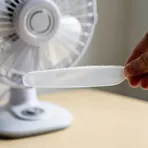
A machine with turning blades that uses electricity to move air and cool a room or people



- Specialized

 1
7.5
1
7.5
A fan-shaped area of sand and stones that forms where a fast stream slows and spreads at a mountain base

 1
9.9
1
9.9
A Chinese gambling game where players bet on how many counters remain under a bowl after grouping them by four



- Australian
A large plant that grows in Australia and New Zealand with fan-shaped leaves that split many times


- Specialized
A stone ceiling with ribs that spread out like a fan in Gothic churches

- Specialized
An engine with a large fan that pushes extra air to make the plane go faster




- Specialized
A small tropical plant with fan-shaped leaves, thin stems, and loose fibers at the leaf bases


How Strong

Surface Forms
Etymology
Fan The verb fan comes from the simple action of waving a flat object, like a piece of paper or your hand, to move air and cool something. So, to fan is to 'move air' or blow something away.