
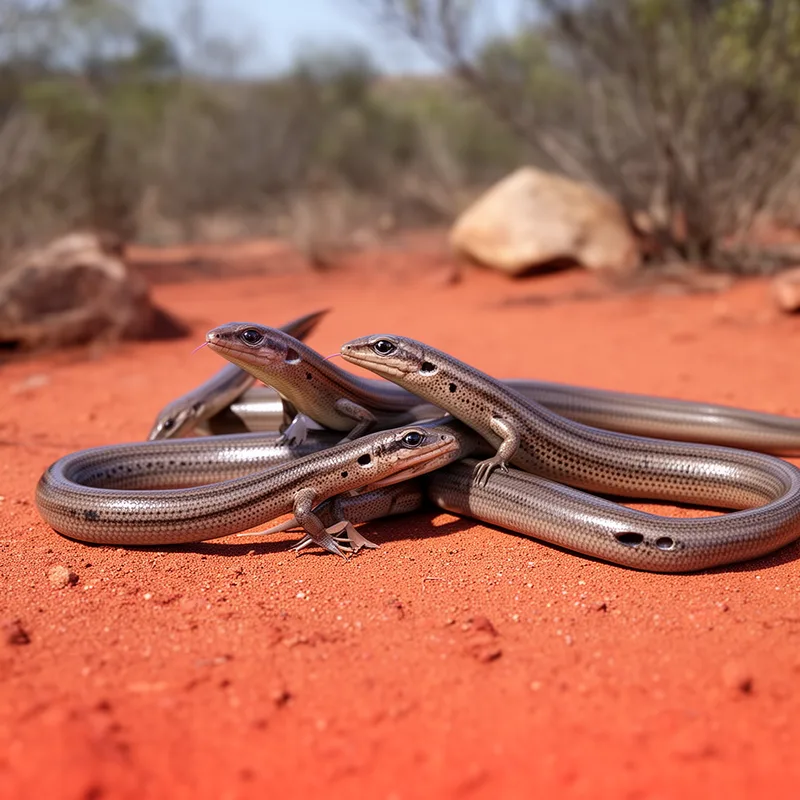
family Pygopodidae
- noun
- /ˈfæmɪli pɪˈɡoʊpəˌdaɪ/
- Specialized
- Unlike true snakes, members of the family Pygopodidae retain vestigial hind limbs.
Examples
-
The family Pygopodidae includes about 45 species of legless lizards native to Australia.
-
The family Pygopodidae is known for its remarkable adaptations to a burrowing lifestyle in Australia.
-
Scientists are studying the evolutionary adaptations of the family Pygopodidae to understand their snake-like features.
-
The family Pygopodidae includes several unique species.
-
Did you know that the family Pygopodidae has no legs?
-
Researchers have discovered that the family Pygopodidae comprises various legless lizards that thrive in diverse habitats.
-
In the family Pygopodidae, the snakes have evolved unique features that distinguish them from their lizard relatives.
Synonyms
A family of legless lizards from Australia and Tasmania that look like snakes
Surface Forms
Morphology
The phrase is fully compositional: 'family' denotes a scientific taxonomic grouping and 'Pygopodidae' names the group of legless lizards, so the meaning (‘the family of Pygopodidae lizards’) is directly derivable from the parts. Taxonomic naming conventions are regular and cross-linguistically similar, making this immediately comprehensible to learners who know both constituents.
Etymology
Family Pygopodidae comes from old Greek parts meaning pygo 'rear' and pod 'foot', giving the image of a tiny foot at the back of the animal. These lizards look like snakes but keep small hidden hind limbs, so the name helps you remember they are a family of 'legless' or nearly legless lizards.

