
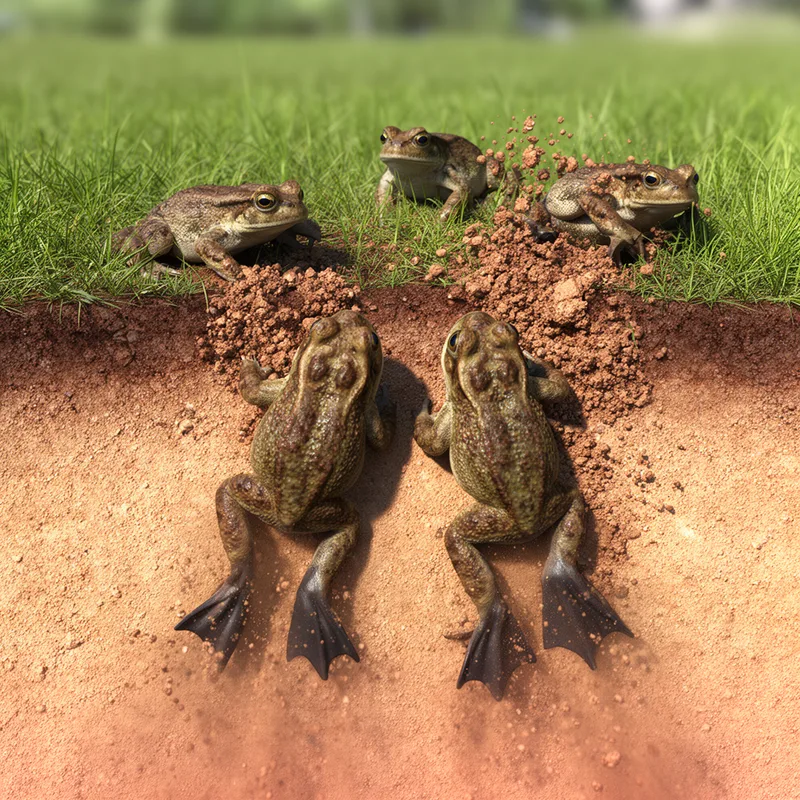
family Pelobatidae
- noun
- /ˈfæmɪli pɛloʊˈbeɪtɪdeɪ/
- Specialized
- Many members of the family Pelobatidae are known for their distinctive spade-like projections on their hind feet.
Examples
-
The family Pelobatidae includes several species adapted to a burrowing lifestyle.
-
Several European and North American toads belong to the family Pelobatidae.
-
Biologists study the family Pelobatidae to learn more about amphibian evolution.
-
The family Pelobatidae includes various species of spadefoot toads.
-
Many members of the family Pelobatidae are well adapted to arid environments.
-
The family Pelobatidae consists of unique amphibians that thrive in sandy soils.
-
Researchers explore the family Pelobatidae to understand their specialized burrowing behaviors.
Synonyms
A family of burrowing toads with spade-like back feet for digging
Surface Forms
Morphology
The phrase 'family Pelobatidae' is directly compositional: 'family' denotes a taxonomic grouping and 'Pelobatidae' is the name of the taxon (spadefoot toads). This naming pattern (family + taxon name) is a standard, cross-linguistic scientific convention, so a learner who knows both constituents can infer the meaning.
Etymology
Family Pelobatidae comes from the Greek name Pelobates, made from parts pelo- meaning 'mud' and -bates meaning 'walker'. These toads have spade-like back feet for digging in mud, so the name points to their burrowing life.

