
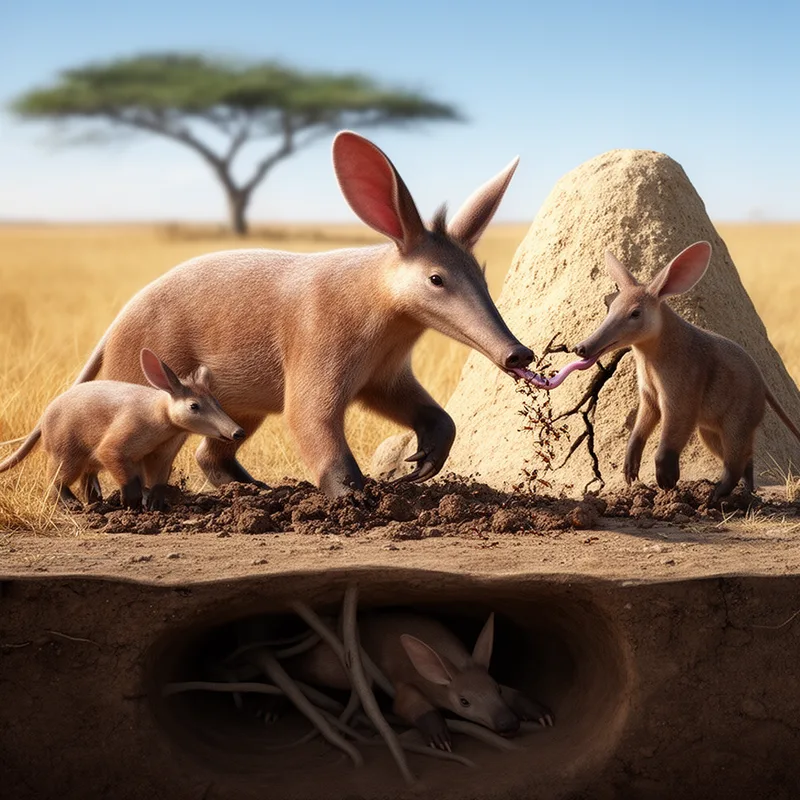
family Orycteropodidae
- noun
- /ˈfæmɪli ɔrɪktəˈrɒpəˌdɪdi/
- Specialized
- The family Orycteropodidae includes only one living species, the aardvark.
Examples
-
In the family Orycteropodidae, the aardvark is the only surviving member, with unique adaptations for burrowing.
-
The unique dentition of the family Orycteropodidae distinguishes it from other mammalian families.
-
Researchers studied the evolution of burrowing behaviors in the family Orycteropodidae.
-
The family Orycteropodidae includes the unique aardvark.
-
Many species of the family Orycteropodidae are nocturnal.
-
The family Orycteropodidae is known for its specialized feeding habits on ants and termites.
-
Members of the family Orycteropodidae exhibit distinctive characteristics that make them well-suited for their insectivorous diet.
Synonyms

A group of African mammals that dig burrows and eat ants and termites, including the aardvark

A group of mammals that includes the aardvark
Surface Forms
Morphology
family + Orycteropodidae
The phrase is compositionally built from the noun 'family' (a scientific grouping) plus the taxonomic name 'Orycteropodidae', so a learner who knows 'family' and recognizes the capitalized name can infer it means 'the family called Orycteropodidae' (i.e., the taxonomic group that includes the aardvark). This category+name pattern is cross-linguistically common and follows straightforward English composition, making the meaning derivable from the constituents.
Etymology
Family Orycteropodidae may come from old Greek words orykter meaning 'digger' and podos meaning 'foot', giving the clear picture of a 'digging foot'. So the name fits the group because animals like the aardvark use strong feet to dig for ants and live in burrows.

