

family Myrmeleontidae
- noun
- /ˈfæmɪli ˌmɪrˌmɛlɪˈɒnˌtiːdeɪ/
- Specialized
- The family Myrmeleontidae is best known for species whose larvae construct pitfall traps to capture ants.
Examples
-
Several members of the family Myrmeleontidae are found in sandy environments worldwide.
-
The family Myrmeleontidae consists of insect species that are often referred to as antlions.
-
Researchers studied the wing structure variation across the family Myrmeleontidae.
-
The family Myrmeleontidae includes many fascinating species.
-
Did you know that the family Myrmeleontidae is known for its unique larvae?
-
One interesting fact about the family Myrmeleontidae is that their larvae are known for building traps in sand to catch prey.
-
Scientists have identified numerous species within the family Myrmeleontidae, which can be found in various habitats around the world.
Synonyms
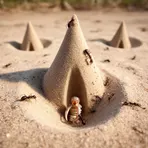
A family of insects whose young dig cone-shaped pits to trap ants and small insects
Surface Forms
Morphology
The phrase is directly compositional: 'family' (a scientific grouping) combined with 'Myrmeleontidae' (the name of an insect family) yields the literal meaning 'the taxonomic family Myrmeleontidae'. This follows standard noun + proper-name composition and would be immediately understandable to B1 learners who know both constituents.
Etymology
Family Myrmeleontidae comes from Greek parts myrmex and leon, which mean 'ant' and 'lion'. People called these insects 'ant-lions' because the young insects dig small cone-shaped pits and wait like tiny lions to catch ants, so the scientific name points to their hunting habit.

