
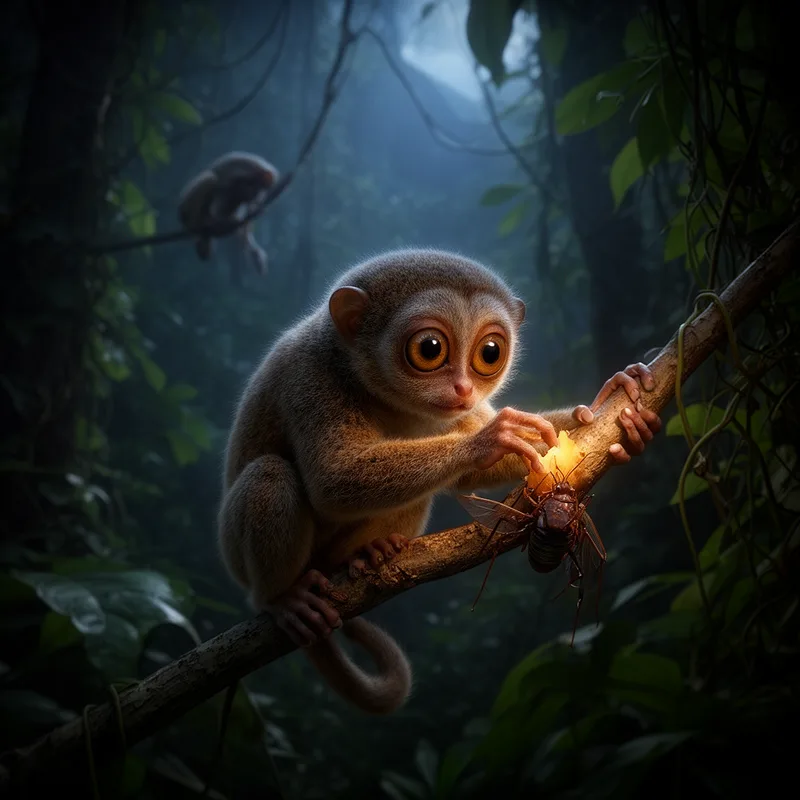
family Lorisidae
- noun
- /ˈfæmɪli ˌlɔːrɪˈseɪdi/
- Specialized
- The slow loris, a member of the family Lorisidae, is found in Southeast Asian forests.
Examples
-
Researchers are studying the conservation status of several family Lorisidae species due to habitat loss.
-
Most members of the family Lorisidae are nocturnal and feed on fruit, insects, and small animals.
-
The family Lorisidae includes species like the slow loris.
-
Did you know that the family Lorisidae is nocturnal?
-
Most members of the family Lorisidae are nocturnal and feed on fruit, insects, and small animals.
-
The slow loris, a member of the family Lorisidae, is found in Southeast Asian forests.
-
Researchers are studying the conservation status of several family Lorisidae species due to habitat loss.
Synonyms

A small slow primate from tropical Asia that is active at night and usually has no tail
Surface Forms
Morphology
The noun 'family' denotes a taxonomic grouping and 'Lorisidae' names a particular primate taxon, so the phrase straightforwardly means the taxonomic group of those primates. This compositional pattern (family + taxon name) is standard in scientific naming and cross-linguistically common, so a B1 learner who knows both constituents can infer the meaning.
Etymology
Family Lorisidae may come from an old Dutch word loris that meant 'clown' or 'simpleton', a name given because these animals have round faces, big eyes and move very slowly. That's why the name came to mean the group of slow, big-eyed primates we know today.

