

family Lepisosteidae
- noun
- /ˈfæmɪli ˌlɛpɪˈstoʊɪdi/
- Specialized
- The family Lepisosteidae includes several species of gars.
Examples
-
Members of the family Lepisosteidae are notable for their elongated jaws and sharp teeth.
-
Fish belonging to the family Lepisosteidae can often be found in shallow waters of lakes and rivers.
-
Researchers study the family Lepisosteidae to learn more about evolutionary adaptations in fish.
-
The prehistoric look of the family Lepisosteidae sets gars apart from other freshwater fish.
-
Many fish enthusiasts are fascinated by the family Lepisosteidae.
-
The family Lepisosteidae is known for its ancient lineage and unique skeletal structure.
-
Aquatic biologists often discuss the characteristics of the family Lepisosteidae in their research.
Synonyms
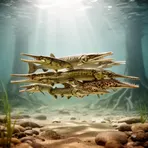
A family of long, sharp-toothed freshwater fish found in North and Central America
Surface Forms
Morphology
The phrase is a straightforward taxonomic label combining 'family' (a scientific grouping) with the proper name 'Lepisosteidae', so the meaning—a family of fishes called Lepisosteidae—is directly derived from its parts. This compositional pattern (rank + taxon name) is standard in scientific language and cross-linguistically familiar, making it immediately understandable to learners who know both constituents.
Etymology
Family Lepisosteidae comes from two Greek words, lepis meaning 'scale' and osteon meaning 'bone', because these fish have hard, bony scales. So the name helps you remember that this family is the 'gars' known for their armored scales and long jaws.

