
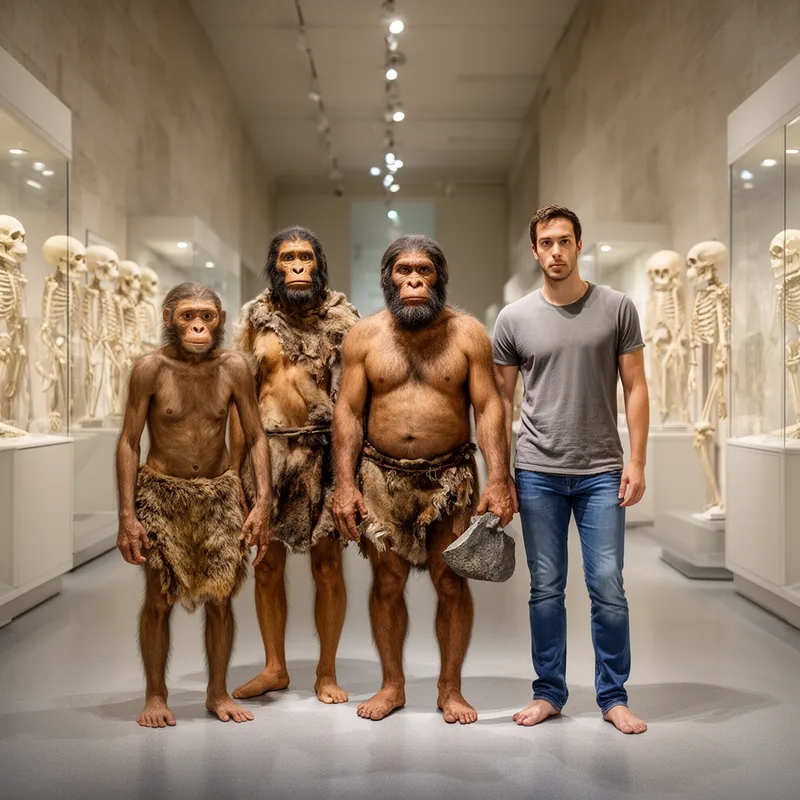
family Hominidae
- noun
- /ˈfæmɪli ˈhɒmɪnɪdeɪ/
- Specialized
- Researchers categorize modern humans within the family Hominidae, highlighting our connection to apes and early human ancestors.
Examples
-
The family Hominidae encompasses not only humans but also extinct species that were part of our evolutionary history.
-
Art making is now species-specific because humans are the only surviving species in the genus Homo of the family Hominidae.
Academic text (1998) -
Modern humans belong to the biological family Hominidae, which also includes our closest relatives and ancestors.
Synonyms

A family of great apes that includes humans, chimpanzees, gorillas, and orangutans
Surface Forms
Morphology
The phrase simply combines the common noun 'family' (a taxonomic grouping) with the taxon name 'Hominidae', so its meaning is directly and compositionally derived from its parts. This is a standard, cross-linguistic biological naming pattern, so a learner who knows both constituents can immediately infer that it refers to the Hominidae family (modern humans and close relatives).
Etymology
Family Hominidae is a scientific name. Hominidae comes from a word for 'human' and literally means the 'human family', so it is used for the group that includes 'modern humans' and their close ancestors who lived long ago.

