
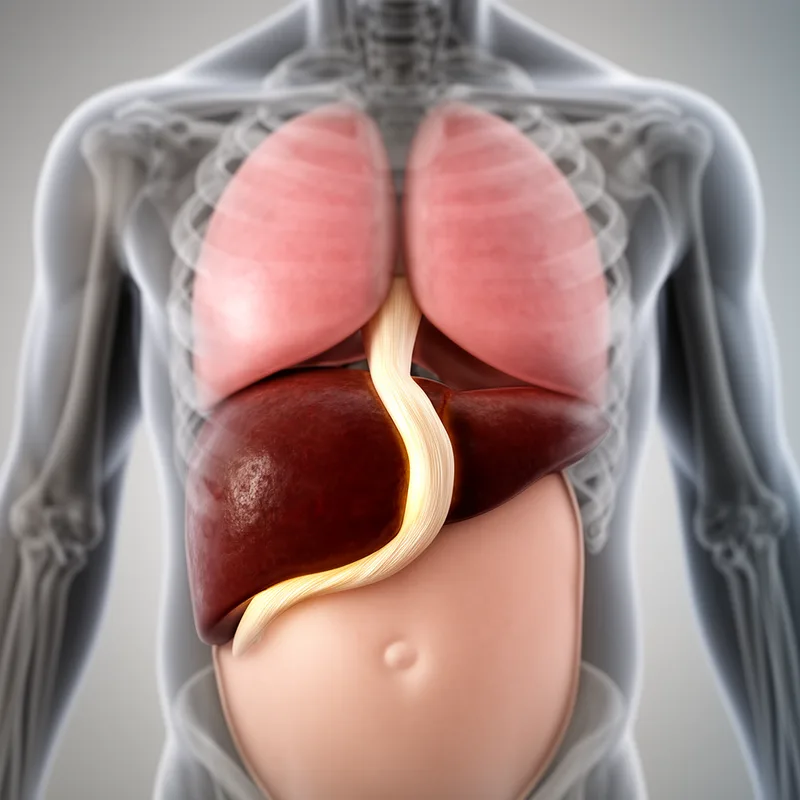
falciform ligament
- noun
- /ˈfɔl.sɪ.fɔrm ˈlɪɡ.ə.mənt/
- Specialized
- The falciform ligament connects the liver to the diaphragm.
Examples
-
In human anatomy, the falciform ligament separates the left and right lobes of the liver.
-
The surgeon identified the falciform ligament before proceeding with the liver operation.
-
The medical student learned to locate the falciform ligament during her anatomy class.
-
Surgeons often examine the falciform ligament during liver operations.
-
The surgeon identified the falciform ligament before proceeding with the liver operation.
-
The medical student learned to locate the falciform ligament during her anatomy class.
-
The falciform ligament connects the liver to the diaphragm.
Surface Forms
Morphology
The compound is fully compositional: 'falciform' means 'sickle-shaped' and 'ligament' is a connective tissue, so a learner who knows both constituents can infer it is a sickle-shaped ligament. Although anatomical/technical, the formation is descriptive and follows transparent modifier + noun patterns common across languages, so the meaning is directly derivable from its parts.
Etymology
Falciform ligament gets its name from its shape: falciform means 'sickle-shaped' and ligament is a thin band of tissue. Because this thin, curved band attaches the liver to the diaphragm and the front of the belly, the name gives a clear picture of what it is.

