
extraocular
 1
7.4
1
7.4

- adjective
- /ˌɛkstrəˈɑkjələr/
- Specialized
- There was no involvement of the swallowing, neck, and extraocular muscles.
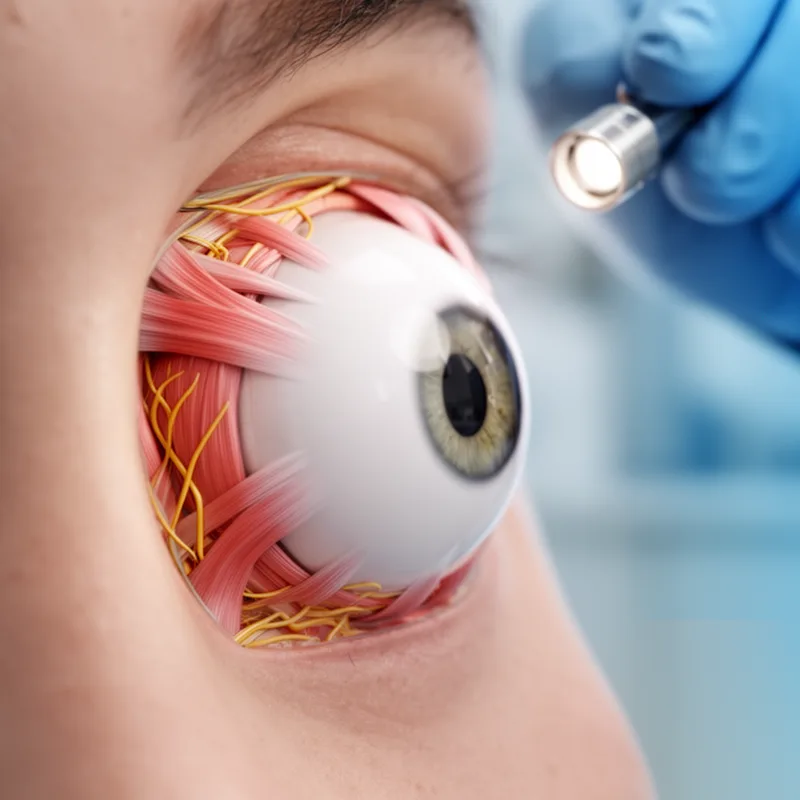
- extraocular muscles
- extraocular movement
Examples
-
All patients had full restoration of extraocular movements and resolution of infraorbital dysesthesia.
Academic text (2011) -
Extraocular movement is impaired, and visual acuity might be impaired at a later stage.
Academic text (2002) -
In addition to historical and physical assessment, photographs and video of extraocular movement were obtained for each patient seen.
Academic text (2011) -
During evaluation, paralysis of the extraocular muscles prevents the patient from moving her left eye.
Academic text (2008) -
The patient's extraocular muscle movements and visual acuity were intact bilaterally.
Academic text (2002) -
MRIs demonstrate the invasion of the orbit and displacement of extraocular muscles.
Academic text (2009) -
All patients demonstrated complete extraocular movements (including the patient in Figure 1) and full resolution of infraorbital dysesthesia (Figure 2).
Academic text (2011) -
On initial presentation, 73% of the patients had diplopia, 45% demonstrated decreased extraocular movements, 18% had enophthalmos, and 82% experienced infraorbital numbness.
Academic text (2011) -
Recognized clinical effects of orbital floor fractures include diplopia, impaired extraocular muscle motility, enophthalmos, hypoglobus, and infraorbital dysesthesia.
Academic text (2011) -
The doctor examined the patient's eyes and noted good extraocular movements during the check-up.
Synonyms
 7
7.0
7
7.0
The eye socket and area around the eye
 1
8.0
1
8.0
Near the eye socket that holds the eye

Around the eye
Antonyms

How Ocular

Surface Forms
Morphology
Etymology
Extraocular is made of extra- ('outside') and ocular ('eye'), the same ocular you see in binocular. So, Extraocular means something that is 'outside' the eyeball, like the muscles or tissues around the eye.