
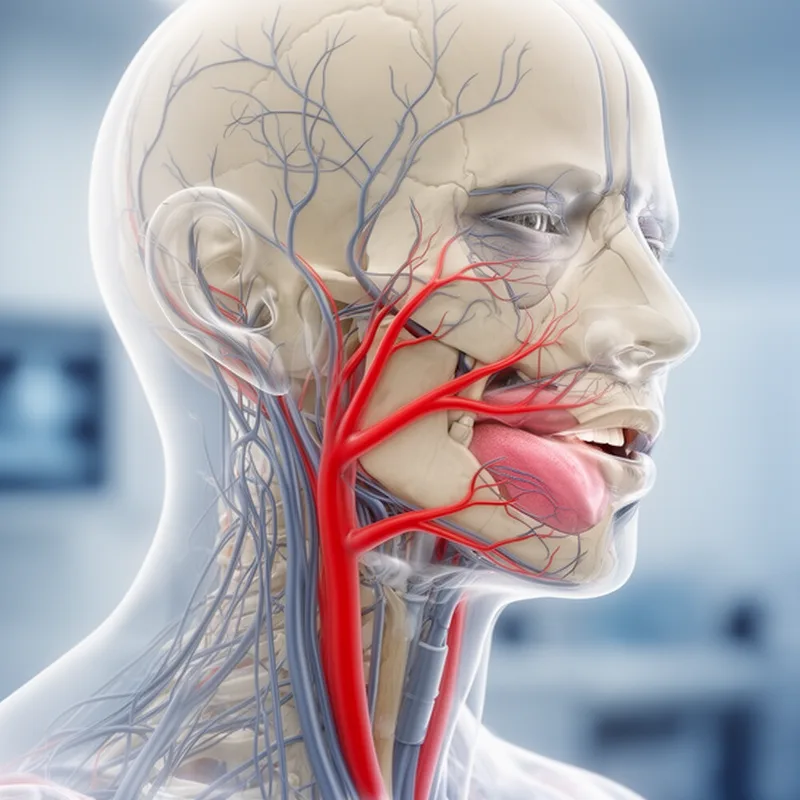
external carotid


 1
5.6
1
5.6
- noun
- /ɪkˈstɜrnəl kəˈrɑtɪd/
- Specialized
- The external carotid artery provides blood to the face and neck regions.
- external carotid artery
- branch of the external carotid
Examples
-
The external carotid artery is crucial for supplying blood to the scalp and jaw.
-
Surgeons need to be careful when operating near the external carotid artery to avoid damaging it.
-
Embolization was performed to interrupt the 20% blood supply from the sphenopalatine branches of the external carotid artery.
Academic text (2001) -
While talking to the patient, the internal carotid, common carotid, and external carotid arteries were cross-clamped.
Academic text (2007) -
For example, performing external carotid artery ligation risks damage to the hypoglossal and vagus nerves.
Academic text (2005) -
Given the large size of the tumor and the adequate size of the feeder vessels, preoperative embolization of the external carotid artery was performed.
Academic text (2005) -
Knowledge of the migratory pattern of these muscles and the branches of the facial nerve and external carotid artery that they carry with them is helpful in understanding the complex anatomy of the human adult.
Academic text (2003) -
Angiography of the right internal and external carotid arteries excluded aneurysmal dilation and a vascular tumor.
Academic text (2006) -
Carotid angiography demonstrated characteristics typical of a large glomus tumor that was supplied primarily by branches of the external carotid artery (Figure 2).
Academic text (2005) -
The rich blood supply to this muscle and to the auricle is largely derived from perforating branches of the posterior auricular artery, which is a branch of the external carotid artery.
Academic text (2009)
Synonyms

A blood vessel that carries blood from the neck to the face, tongue, and outer parts of the head
How Superficial
- Specialized
1
5.6

- Specialized
1
4.5
Surface Forms
Morphology
The meaning is a straightforward composition: 'external' (outer) modifies 'carotid' (the carotid artery), yielding the outer/externally directed branch of the carotid. This morphological logic is literal and cross-linguistically common (e.g. Spanish 'carótida externa'), so a learner who knows both constituents can infer the MWE meaning.
Etymology
External carotid comes from two parts: external meaning 'outside' and carotid from a Greek word meaning 'to make sleepy', because pressing the neck artery could make someone faint. The name fits because the external carotid is the branch of the main carotid artery that goes to the face, tongue and other outer parts of the head.