
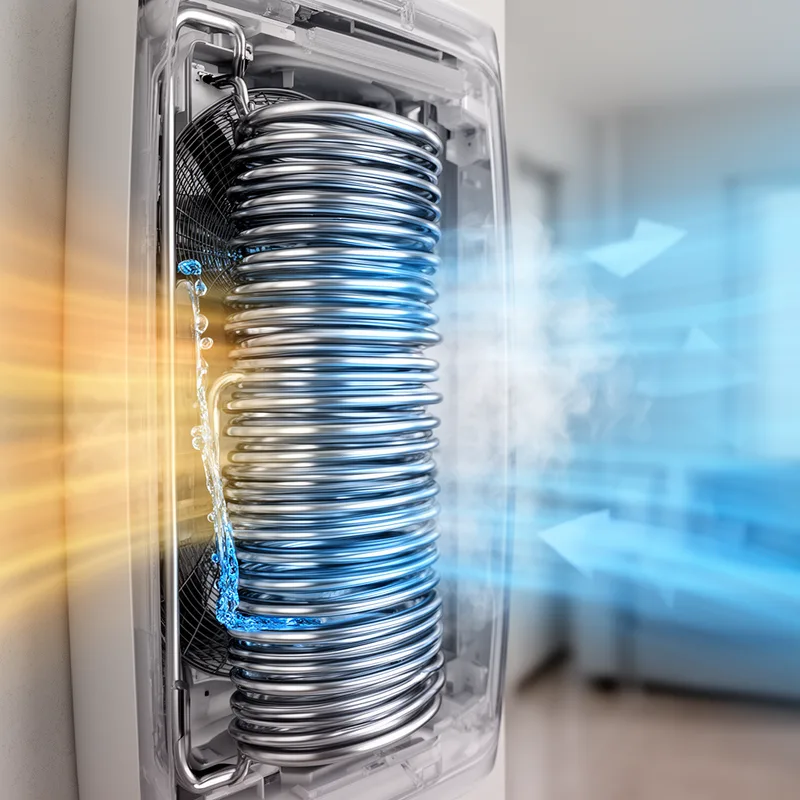
evaporator
 1
4.4
1
4.4

- noun
- /ɪˈvæpəˌreɪtər/
- Specialized
- The shredded waste flows into an evaporator that houses a screw driven by a computer-controlled variable-speed AC motor.
- a rotary evaporator
- a vacuum evaporator
Examples
-
In refrigeration systems, the evaporator absorbs heat, allowing the liquid refrigerant to turn into vapor and cool the air.
-
Researchers conceptualized a two-chamber, closed-loop device with an evaporator chamber at the chip and a condenser some distance away connected through tubing.
Academic text (2001) -
And then for the cold side, I guess the evaporator is over here embedded in the water tank.
-
The evaporator, therefore, had to be more compact than a typical heat sink.
Academic text (2001) -
So it's frosted over anywhere where the evaporator is exposed to the air, which makes perfect sense.
-
Because of the manual adjustment and icing problems on the evaporator coils, the conversion process could take up to 24 hours to complete.
Academic text (2002) -
The evaporators would be clamped down on the chips, much like the conventional heat sinks.
Academic text (2001) -
The product is suitable for refrigerant condensers and evaporators, and oil coolers in engines.
Academic text (2006) -
We had to wire all the components: compressor, evaporator coil, condensing coil.
Academic text (2008) -
The copper structure, consisting of a three-dimensional interconnected network of microchannels, was soldered to the inside surface of the evaporator bottom.
Academic text (2001)
Antonyms


Surface Forms
Morphology
Etymology
Evaporator comes from the verb evaporate, made of e- meaning 'out' and vapor meaning 'steam'. So an evaporator is a machine that turns liquid into 'steam' or gas so the liquid goes out, which is why it removes liquid for cooling or drying.