
eusociality


 1
9.9
- noun
- /juːˌsoʊʃiˈælɪti/
- Specialized
- In evaluating such evidence, it is worth stressing that the attainment of eusociality has been a rare event in the evolutionary history of animals.
- reproductive altruism
- evolution of eusociality
- origin of eusociality
Examples
-
Among these latter few, a single one, the Australian eucalyptus-boring beetle Platypus (Austroplatypus incompertus), is known to have developed eusociality.
Academic text (2008) -
A second preadaptation that favors the transition to eusociality is the propensity, documented in solitary bees, to behave like eusocial species when forced together experimentally.
Academic text (2008) -
Why has eusociality been so successful?
Academic text (2008) -
The total number of known origins of eusociality in arthropods overall is 13.
Academic text (2008) -
Wilson charts two distinct evolutionary paths to eusociality, one taken by the social insects, the other by ourselves.
Blog text (31) -
Numerous genetic studies in insects, other invertebrates, and vertebrates have shown that eusociality evolved in groups of highly related individuals
Academic text (1999) -
In this article, I argue that the origin of altruism leading to eusociality cannot be deduced by aprioristic reasoning based on general models.
Academic text (2008) -
As an overarching principle, the final step to eusociality can occur with the substitution of only one allele or a small set of alleles.
Academic text (2008) -
The key preadaptation for eusociality in the social Hymenoptera is progressive provisioning, a behavior that in solitary species arises by individual direct selection.
Academic text (2008) -
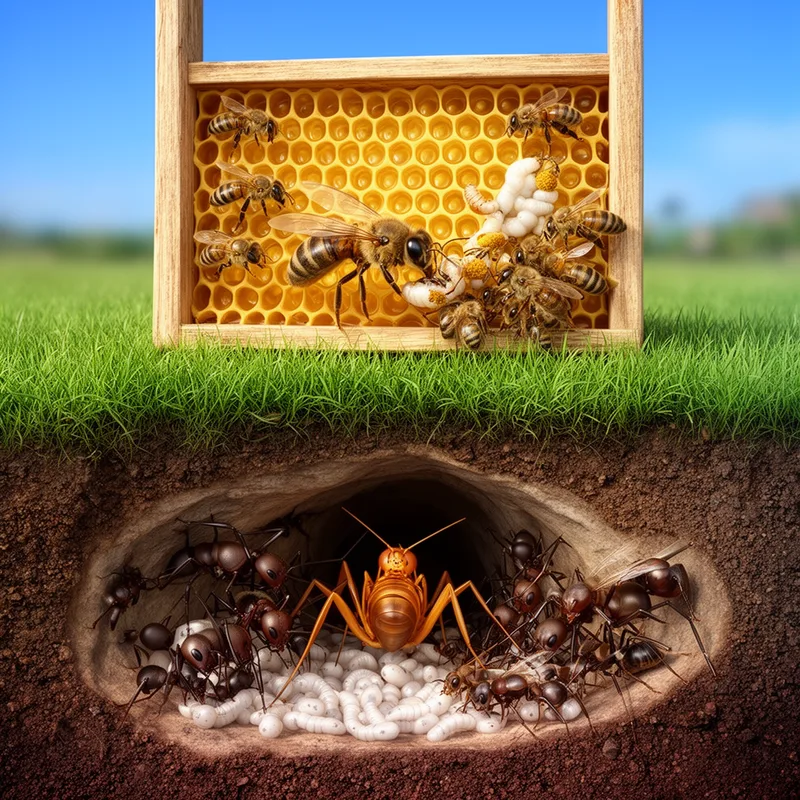
In eusociality, many insects, like ants and bees, sacrifice their ability to reproduce to care for their colony.
Antonyms


How Social

Surface Forms
Morphology
Etymology
Eusociality is made of eu- meaning 'good' or 'well' and social meaning 'living with others', so it means a 'truly social' way of life. That's why eusociality describes animals like ants and bees where some members give up having babies to help the group.