
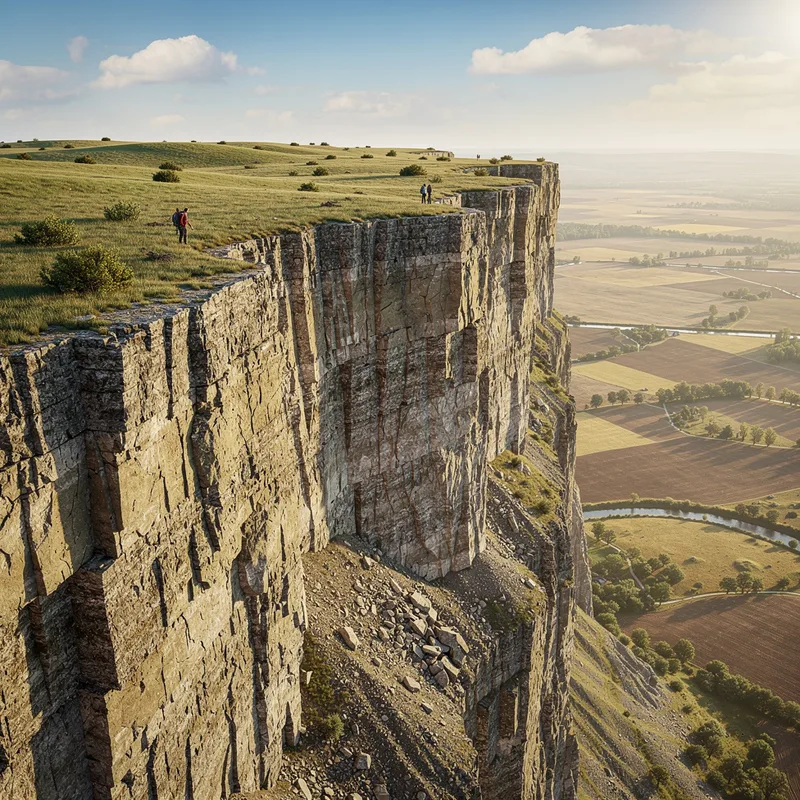
escarpment
 3
8.2
3
8.2

- noun
- /ɪˈskɑːrpmənt/
- We stood at the top of the escarpment, surveying the lush valley below as the sun began to set.
- a steep escarpment
- a high escarpment
- the western escarpment
Examples
-
About a half-mile down, under a sunny gray shale escarpment, there was a party in session.
Fiction book (1994) -
Here, the cliffs of the Tuwaiq escarpment drop away, giving splendid views over the plain below.
Blog text (5) -
We're heading for that escarpment today, right?
-
See what you make of that, over there, below the escarpment.
-
Many of the latrine sites were along the edge of the high escarpment.
Academic text (1990) -
His eyes rise to the escarpment soaring above the jungle floor.
Fiction book (1992) -
Jane had stopped midway between the car and the edge of the escarpment.
Fiction book (1990) -
On top of the escarpment is the Malahafaly Plateau, which makes up about two-thirds of the reserve.
Academic text (1990) -
In one place, a deep, velvety lagoon is surrounded by high rock escarpments, where many paintings are displayed.
Academic text (2002) -
Water erosion of the salt collapsed the rocks, leading to sunken valleys and escarpments that are evident throughout the region.
Academic text (2011)
Synonyms
 438
1.0
438
1.0
A high, steep edge of rock or ground often by the sea
 27
7.4
27
7.4
A very steep cliff with a sudden drop
 5
5.5
5
5.5
A very steep edge of land or rock
 4
3.4
4
3.4
The steep side of a cliff that looks over the sea
 1
9.1
1
9.1
A long steep slope or cliff at the edge of a high flat area


 1
8.5
1
8.5
A layer of hard rock forming the steep edge of a high flat area or canyon
How Steep

Surface Forms
Morphology
escarpment = escarp + ment
The word is a borrowing containing a non‑English root plus '-ment'; the components do not transparently convey the geological meaning to an average learner.
Etymology
Escarpment comes from French escarpe, meaning 'slope' or 'steep bank'. So an escarpment today is a long, steep slope or cliff between two levels of land, often formed by erosion.