

epiphyte
 4
9.9
4
9.9

- noun
- /ˈɛpɪˌfaɪt/
- Specialized
- Hydnophytum, an epiphyte living on the branches of rainforest trees in Borneo, is a classic example.
- trees and epiphytes
- epiphytes—plants
Loading YouTube…
Watch on YouTubeIf you remember tree beard out of Lord of the Rings, he had one of the epiphyte like growths off his beard, which was from the Puhu Takawa.
- If you remember tree beard out of Lord of the Rings, he had one of the epiphyte like growths off his beard, which was from the Puhu Takawa.
Examples
-
Many types of orchids and epiphytes thrive in the humid environment of rainforests.
-
Most orchids that live in the tropics are epiphytes, in contrast to temperate orchids, which are all terrestrial.
Academic text (1991) -
Some trees even produce chemicals that keep the bark free of epiphytes.
Academic text (1991) -
Insects find niches in the managed shade trees and the epiphytes that live upon them.
Academic text (1999) -
A third major group of epiphytes is bromeliads, or members of the pineapple family.
Academic text (1991) -
Epiphytes grow on trees, but they're not parasites.
-
The protected inner dunes provide a habitat for palms and low broad-leaved trees, including rare Thrinax palmettos, cacti, and epiphytes.
Academic text (1993) -
The epiphyte clung to the tree branches, soaking up moisture from the air.
-
Unlike parasites, epiphytes obtain nutrients from rain and air while providing no harm to their host plants.
Synonyms
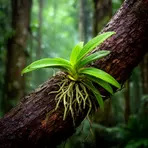
A plant that lives on another plant without hurting it and gets water from air and rain

A plant that needs no soil, takes water and food from air and rain, lives on other plants without harm

A plant like an orchid that grows on another plant and takes water and nutrients from air and rain
How Soil-Free

Surface Forms
Morphology
epiphyte = phyte (semi-transparent) = epi + phyte
Formed from epi- ('upon') + -phyte ('plant'); clear for those familiar with botanical combining forms but not necessarily transparent to an average B1 learner.
Etymology
The word epiphyte comes from the Greek parts epi- meaning 'upon' and phyte meaning 'plant', so it literally means 'a plant that grows on another plant'. That's why epiphytes take water and nutrients from the air and rain and do not harm the plants they live on.