
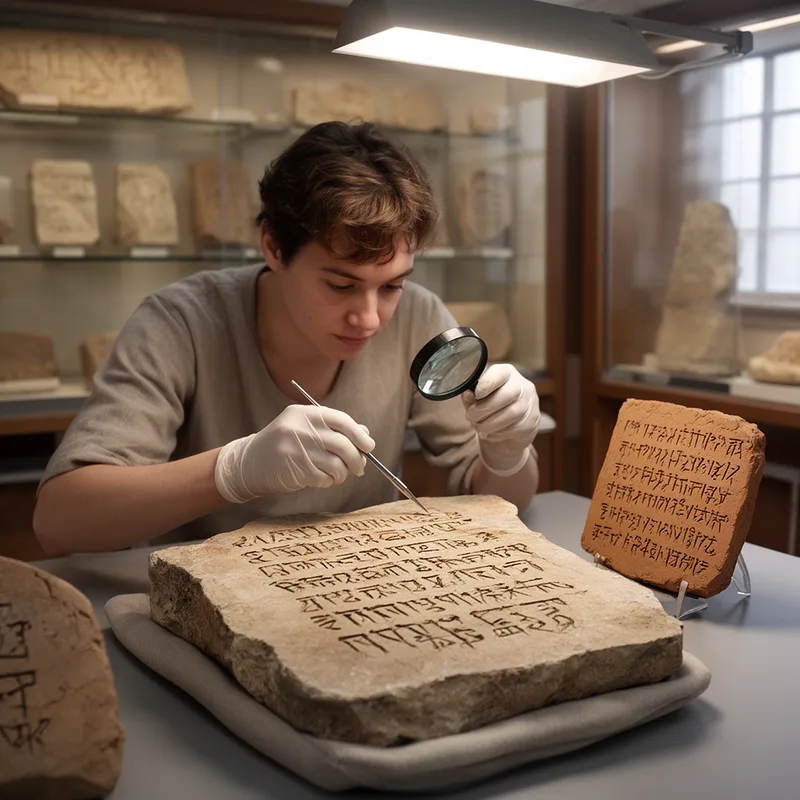
epigraphy


 1
9.9
1
9.9
- noun
- /ɪˈpɪɡrəfi/
- Specialized
- The archaeologist specialized in epigraphy, studying ancient inscriptions on stone tablets.
Examples
-
However, in some respects, the inscription is typical of medieval epigraphy.
Academic text (2005) -
A forum fixture is Alicia Canto, professor of classical archaeology and epigraphy at the Universidad Autónoma de Madrid.
Academic text (2009) -
As far as Hebrew epigraphy goes, I am an expert.
Blog text (11) -
Then along came Robertson, whose interest in art history, he says, "actually brought epigraphy back to life."
Academic text (2002) -
Epigraphy was "in the doldrums," recalls Chase.
Academic text (2002) -
Mantegna's skill in rendering stone surfaces is legendary, as is his fascination with the remains of the classical past, including epigraphy.
Academic text (1998) -
In 1973, he made a life-changing decision to abandon his echinoderm research and turn to the study of epigraphy, founding the Epigraphic Society in July 1974 with his wife Rene and their friend Peter Garfall.
Blog text (11) -
The role of the portal in the liturgy of dedication deeply influenced medieval epigraphy, for the majority of medieval inscriptions in church portals relate to the portal's liturgical dedication.
Academic text (2005) -
In her classes, she introduced students to the principles of epigraphy and its importance in understanding ancient cultures.
-
Through his research in epigraphy, he uncovered new details about the ancient civilization's history.
Surface Forms
Morphology
Etymology
Epigraphy comes from the Greek parts epi- 'on' and graphein 'to write', so it literally means 'writing on'. So, epigraphy is the study of writings carved or written on stone and other hard materials, which helps historians read messages from ancient people.