
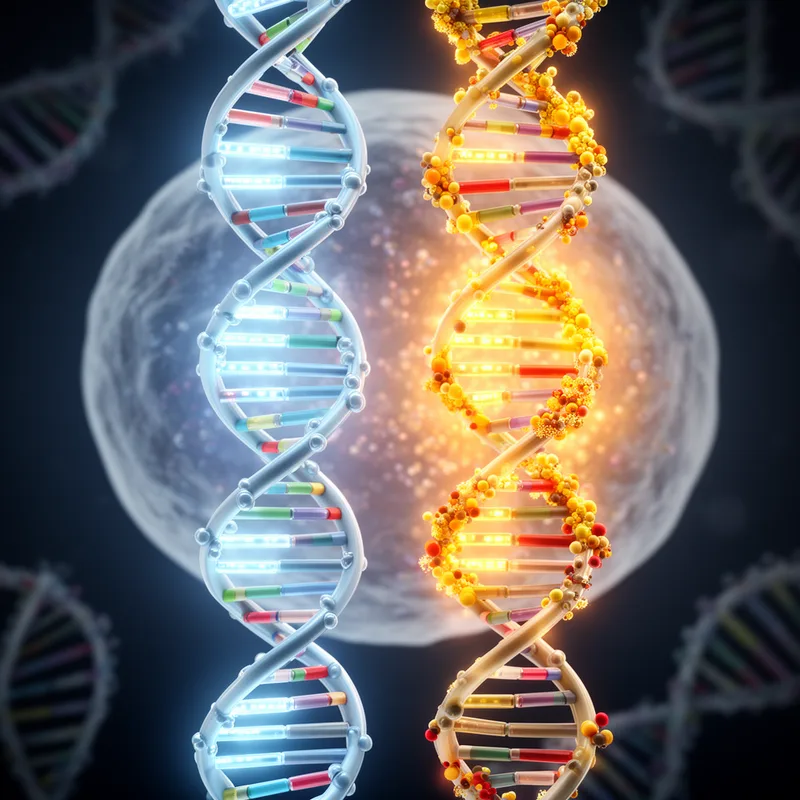
epigenetic
 3
7.5
3
7.5

- adjective
- /ˌɛpɪdʒəˈnɛtɪk/
- Specialized
- Several studies have examined links between ART and epigenetic marks.
- epigenetic mechanism
- epigenetic changes
- epigenetic inheritance
Loading YouTube…
Watch on YouTubeIt slows down this clock of epigenetic changes, which we can measure.
- It slows down this clock of epigenetic changes, which we can measure.
- Will it have indeed an effect, an epigenetic transgenerational effect?
- And I remain unconvinced of transgenerational epigenetic inheritance in mammals.
- The new science is called epigenetic control.
- So we're expanding that acute glucose uptake through an epigenetic change.
- And we don't really know right now how to undo all of these epigenetic changes.
- That's how huge the phenotypic change is, and that's absolutely connected with epigenetic changes in gene expression.
- And so the epigenetic modulations go back to just, you know, our immediate ancestors.
- Lot, a lot more to learn epigenetic age reversal.
- EPI means above. So literally epigenetic control reads as control
- So So I've just talked about neurotransmitters, hormones, epigenetic expression, inflammation.
- So one, my my speed of aging using an epigenetic DNA methylation clock.
- Let me tell you the name of it, epigenetic control.
- Your body starts going into a slow shutdown and a epigenetic drift.
Examples
-
For many foods and nutrients, there is some evidence of epigenetic effects, both beneficial and adverse.
Academic text (2012) -
One important factor influencing the epigenetic state of immune cell populations is extracellular signals derived from the tissue microenvironment.
Academic text (2017) -
The new science is called epigenetic control.
-
Each cell type gradually takes on a unique epigenetic profile.
-
Our results help to explain the relationships of epigenetic mechanisms and gene regulation.
Academic text (2014) -
That's how huge the phenotypic change is, and that's absolutely connected with epigenetic changes in gene expression.
-
Nutrients and natural compounds are known to interact with epigenetic phenomena and modify gene expression at the transcriptional level.
Academic text (2017) -
The study of epigenetic factors is crucial for understanding how environmental influences can affect gene expression.
-
Researchers are exploring the epigenetic changes that can occur as a result of diet and lifestyle.
-
Understanding epigenetic modifications can help scientists develop new approaches to treat various diseases.
Surface Forms
Morphology
epigenetic = genetic (transparent) = epi + genet + ic
The form combines the productive prefix 'epi-' (on/above/in addition to) with 'genetic' (relating to genes), yielding the readily derivable meaning 'relating to factors acting on or above genes'.
Etymology
Epigenetic comes from the parts epi- 'on top of' and -genetic 'related to genes' or 'origin', so it literally means 'on top of the genes'. That's why in biology epigenetic changes act 'on top of' the DNA to change how genes work without changing the DNA itself.