

epidermoid
- noun
- /ˌɛpɪˈdɜrmɔɪd/
- Specialized
- Epidermoid carcinoma of the parotid gland has a more aggressive course than other epidermoid carcinomas of the head and neck.
- epidermoid carcinoma
- epidermoid tumors
- cases of epidermoid carcinoma
Examples
-
Treatment options for epidermoids are primarily surgical.
Academic text (2006) -
In a very few cases, epidermoids have undergone malignant transformation.
Academic text (2006) -
Most patients presenting with intracranial epidermoids are in their third or fourth decade of life.
Academic text (2006) -
The most common location is the cerebellopontine angle, where epidermoids account for approximately 9% of all tumors.
Academic text (2006) -
Epidermoid tumors are uncommon but still part of the differential diagnosis of intracranial masses.
Academic text (2006) -
The morphologic and histochemical findings indicated a poorly differentiated epidermoid carcinoma (Figure 3).
Academic text (2008) -
Although rarely, epidermoid carcinoma of the eyelid and conjunctiva can also metastasize to the parotid lymph nodes.
Academic text (2008) -
The patient was later brought back to our institution for removal of the epidermoid, which was accomplished with an image-guided endoscopic sphenoidotomy and marsupialization of the lesion.
Academic text (2006) -
The doctor explained that the epidermoid was a tumor made of squamous cells that could potentially be malignant.
-
After the diagnosis of an epidermoid carcinoma, the patient explored various treatment options with their specialist.
Synonyms
 11
5.8
11
5.8

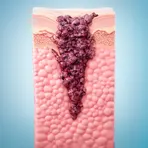
A cancer that starts in the skin or inner layer of organs
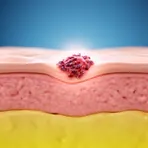
A cancer that starts in the thin tissue covering the body or organs
Surface Forms
Morphology
Etymology
Epidermoid comes from the Greek parts epi- 'on', derm- 'skin' and -oid 'like'. So, an epidermoid tumor is a growth made of skin-like cells and can be malignant, meaning it can grow and spread like cancer.