

epideictic
- adjective
- /ˌɛpɪˈdaɪktɪk/
- Literature
- So, Kennedy consistently uses a host of Western rhetorical terms like judicial, deliberative, and epideictic to make sense of those other traditions, even though the latter are distinctly different from the culture that produced these terms.
- epideictic rhetoric
Examples
-
Lincoln's Gettysburg Address is a splendid sample of epideictic (ceremonial) oratory.
Academic text (1997) -
Her epideictic remarks during the memorial service focused on the legacy of the beloved community leader.
-
Baxandall begins with a detailed analysis of the language of early humanist criticism, which he identifies as the language of epideictic rhetoric.
Academic text (1991) -
This uita is a difficult piece of evidence because, as one writing what amounts to a piece of epideictic literature promoting the dead bishop's cult, Pontius may well have taken the opportunity to exaggerate Cyprian's virtues.
Academic text (2004) -
37 The negotiation of such an apparently paradoxical epideictic space is the essence of these illustrations, a series of "how-to" manuals: "how-to-do" and, by extension, "how-to-know."
Academic text (1995) -
The interpolated dramatizations, sometimes allegorizations, of these Renaissance sermons assimilate the techniques of epideictic homiletics to those of drama, to the antos sacramentales.
Academic text (1990) -
I am suggesting, then, as I have argued in the past, that Vasari's biographies belong to the genre of epideictic rhetoric in its classical and Christianized forms, which means that Vasari was concerned more with the exemplary and universal than with the individual and, therefore, had much in common with the medieval biographer.
Academic text (1991) -
The graduation speech was filled with epideictic language celebrating the achievements of the students.
-
At the awards ceremony, the host delivered an epideictic speech that honored the contributions of the winners.
Synonyms
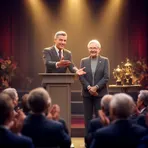
Speech or writing that praises people at ceremonies and celebrates values rather than giving information
Compounds

How Ceremonial


Surface Forms
Morphology
epideictic = deictic (opaque) = epi + deict + ic
A technical rhetorical term formed from Greek combining elements; its meaning ('ceremonial/display rhetoric') is not derivable by average learners from the parts.
Etymology
Epideictic comes from Greek parts epi- meaning 'on' or 'over' and deik- meaning 'to show', so it was originally about things made 'to show' or display. Today epideictic describes speech or writing that is mainly for display or praise at a ceremony, rather than for persuading or teaching.