
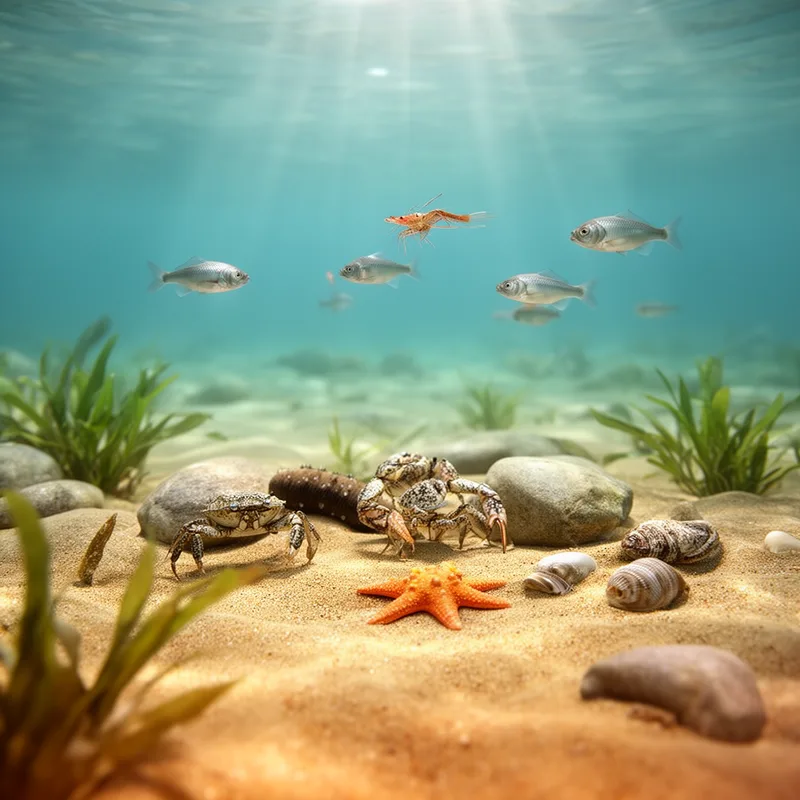
epibenthic
- adjective
- /ˌɛpɪˈbɛnθɪk/
- Specialized
- I continue to use the Smith 1964 manual and the other publications in my research on epibenthic communities and pollution effects.
Examples
-
Is there any obvious relationship (epibenthic, not epibenthic, and so on) between temperature and species composition in the pools?
Academic text (1995) -
Many fish species depend on epibenthic organisms for food and habitat near the lake's bottom.
-
Species were classified as to whether or not they were epibenthic (live on but not in the bottom).
Academic text (1995) -
Increased epibenthic faunal production and biodiversity (Wells 1961, Bahr and Lanier 1981, Lenihan et al. 2001) already captured in fish values.
Academic text (2012) -
Epibenthic organisms, mostly mysids and gammarid amphipods, were also common in stomach contents, with only a small sampling of benthic species (Lowry, 1993).
Academic text (1995) -
The research focused on how epibenthic creatures interact with their environment above the seabed.
-
In coastal areas, epibenthic species play a vital role in maintaining the health of marine ecosystems.
Synonyms

 1
9.6
1
9.6

Relating to the bottom of a sea, lake, or other body of water


 1
6.1
1
6.1
An animal that lives on the bottom of the sea or ocean, for example a fish

Living near the bottom of seas and lakes

On the bottom of a sea or lake
How Close

Surface Forms
Morphology
epibenthic = benthic (transparent) = epi + benth + ic
The prefix 'epi-' meaning 'upon' or 'above' is clearly added to 'benthic', indicating a position on or above the benthic zone.
Etymology
Epibenthic comes from Greek parts: epi- meaning 'on' (as in epicenter or epidermis) and benthic from benthos meaning 'bottom' or 'sea floor'. So, epibenthic describes things that live on or just above the bottom of a sea or lake.