
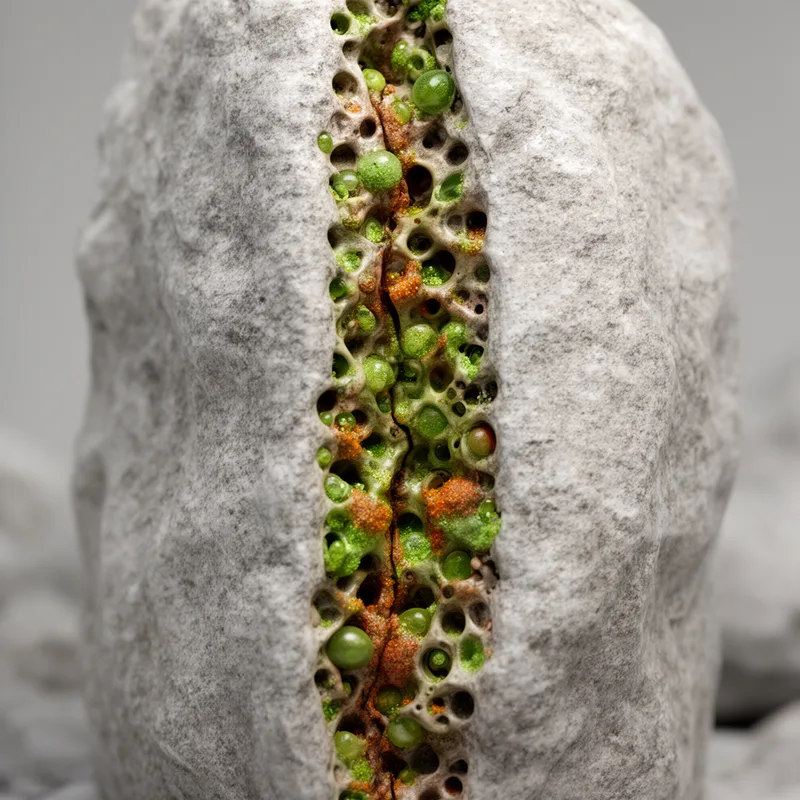
endolithic
- adjective
- /ˌɛndəˈlɪθɪk/
- Specialized
- The endolithic fungi can be found growing within the pores of the ancient stone structures.
- endolithic communities
Examples
-
In extreme climates, endolithic algae are known to live deep inside frozen rocks.
-
In contrast to soil communities, endolithic communities of the dry valleys are active at the present time and may be a modern source of soil organic matter.
Academic text (1999) -
Exfoliation and aeolian transport from endolithic communities.
Academic text (1999) -
Indeed, isotopic signatures of soil organic matter at higher elevations in Taylor Valley have been found to be similar to those of endolithic materials (Burkins et al. in press).
Academic text (1999) -
This latter estimate is much higher than any reported value of organic matter in soils of the dry valleys, but Nienow and Friedmann (1993) proposed that endolithic communities are a significant source of organic matter that is distributed by wind to lower elevations.
Academic text (1999) -
Endolithic organisms thrive in the harsh environment of rock surfaces, making them unique in their ability to survive in such conditions.
How Inside
- Specialized

- Specialized
Surface Forms
Morphology
endolithic = endolith (semi-transparent) = endo + lith + ic
Forming an adjective from the noun 'endolith' with the productive suffix '-ic' is a straightforward derivation.
Etymology
The word endolithic comes from Greek parts endo- meaning 'inside' and lith meaning 'stone', the same root you see in monolith ('single stone'). So, endolithic describes living things that grow or live 'inside' rocks or in the tiny holes of stones.

