

to encrust
 5
6.1
5
6.1

- verb
- /ɪnˈkrʌst/
- The bread was encrusted with a layer of herbs and spices that added flavor.
- encrusted with salt
- encrusted surface
- become encrusted
Examples
-
The rest of his hair, even his sideburns, was encrusted with blood.
Fiction book (1999) -
A thick layer of snow encrusted the trees after the winter storm.
-
On an iron peg to the left of the door hung a heavy, rust-encrusted key.
Fiction book (1991) -
I thought of a rock encrusted with mollusks, but I was tired of marine life.
Fiction book (1993) -
There was a bench nobody was sitting on, encrusted with blotches.
Fiction book (2002) -
The mouth of a pit some forty feet deep, its lichen-encrusted stone walls worn smooth over time.
Fiction book (1998) -
Both men have kerchiefs covering their faces and are totally encrusted with dust.
Fiction book (1990) -
The Ranger listed badly to the right, sending men sliding across the ice-encrusted deck.
Academic text (2011) -
Bad Belly dropped to his knees, hugging the snow-encrusted dog to his chest.
Fiction book (1992) -
The colony is dead and encrusted with numerous sponges and other invertebrates.
Academic text (1993)
Synonyms
 24
7.9
24
7.9
To become covered with a hard or thick layer
 15
3.4
15
3.4
To form a hard outer layer on something as it dries
 1
7.2
1
7.2
To cover something completely, like fog or snow
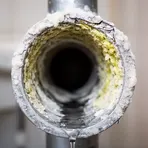
To become covered with a hard layer like salt or scale
Antonyms


How Covered

Surface Forms
Morphology
Etymology
The word encrust comes from the part en- 'in' or 'on' plus crust 'a hard outer layer'. So to encrust something is to put a hard covering on it, like barnacles or mineral deposits on a ship or rock.