

element 112
- noun
- /ˈɛlɪmənt wʌn ˈwʌn ˈtuː/
- Specialized
- Scientists synthesized element 112 for the first time in a laboratory in Germany.
Examples
-
The chemical properties of element 112 are similar to those of mercury.
-
Scientists discovered element 112 in 1996.
-
Researchers continue to study the behavior of element 112 because of its instability.
-
The properties of element 112 are still being studied.
-
Researchers continue to study the behavior of element 112 because it is highly unstable and has unique properties.
-
In 1996, a team of scientists successfully synthesized element 112 in a laboratory in Germany, marking a significant achievement in chemistry.
-
The chemical properties of element 112 are thought to be similar to those of mercury, leading researchers to explore its potential applications.
Synonyms

A very heavy radioactive metal made by scientists and named copernicium
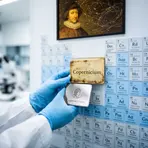
An old name for the element now called copernicium

Former temporary name for element number 112, now named copernicium
Surface Forms
Morphology
element + 112
The phrase 'element 112' is compositionally transparent: a learner who knows 'element' and numbers can infer it denotes the chemical element with atomic number 112 (copernicium). Using an element noun plus its numeric identifier is a direct, cross-linguistically common naming pattern, so the meaning is immediately derivable from the parts.
Etymology
Element 112 began as a simple label scientists gave to a new heavy metal made in a lab. They used element plus the number 112 to show its place in the table of elements, and the metal was later named 'copernicium'. So element 112 now refers to that specific man-made, radioactive metal.

