

electron microscope
 6
4.3
6
4.3

- noun
- /ɪˈlɛktrɒn ˈmaɪkrəˌskoʊp/
- Specialized
- The scientist used a electron microscope to analyze the structure of the tiny particles.
- transmission electron microscope
- scanning electron microscope
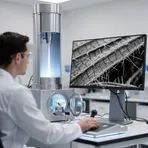
- electron microscope image
Loading YouTube…
Watch on YouTubePhysicists started this with electron microscopes, and it continues today with particle colliders.
- Physicists started this with electron microscopes, and it continues today with particle colliders.
Examples
-
ARS technician Leona Horst loads a fuchsia leaf sample into the variable-pressure scanning electron microscope.
Academic text (2000) -
At this stage, viewed through a scanning electron microscope, the bud still appears symmetrical from the outside.
Academic text (2002) -
Maybe he'll show me his new electron microscope.
-
So these are electron microscope images of some of the samples.
-
Much has been done with fiber research, thanks to the electron microscope.
Academic text (1997) -
Dave is an expert at using electron microscopes to examine extraterrestrial material in fine detail.
Academic text (2001) -
Rachel got to look at samples of Bering Sea water using an electron microscope.
Academic text (1998) -
This is a scanning electron microscope picture of rods and cones.
-
The morphology of the lab-made fiber was investigated using the scanning electron microscope.
Academic text (2007) -
Researchers discovered new details about the virus using their electron microscope.
Synonyms
 102
3.6
102
3.6
A tool that makes very small things look much larger to see details
 1
6.8
1
6.8
A microscope that uses a beam of electrons to show very small surface details

A microscope that uses electrons to show a material's surface in very small detail
How Magnified

Surface Forms
Morphology
The meaning is directly and compositionally derived from 'electron' (the particle) modifying 'microscope' — i.e. a microscope that uses electrons. This head-modifier noun compounding is a regular and cross-linguistic pattern, so a B1 learner who knows both constituents can infer the MWE's meaning.
Etymology
Electron microscope is named from its parts, electron and microscope. It uses a stream of tiny particles called electrons instead of light to create very large images of very small things, so it can 'see' viruses and details normal microscopes cannot.