
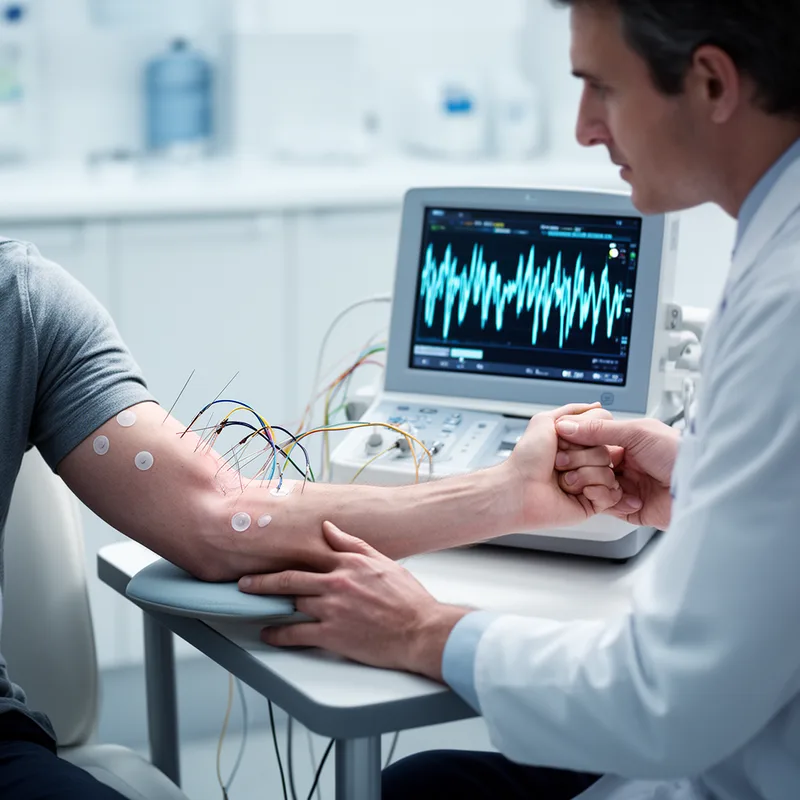
electromyography


 1
8.4
- noun
- /ˌɛlɛktroʊˌmaɪəˈɡrɑfɪ/
- Specialized
- Respiratory muscle activity, assessed by surface electromyography of the left pectoral muscle, was absent immediately before and during this period of apnoea.
- surface electromyography
- electromyography (EMG)
Examples
-
Exploration and neurolysis are only indicated in patients who have no improvement on clinical examination and/or electromyography at 5 to 6 months following injury.
Academic text (2006) -
Electroneurography showed a 98% weakness compared to the other side, and electromyography revealed fibrillation potentials in the oculi, frontalis, and oris muscles.
Academic text (2008) -
Then have you done electromyography or the DITI testing on him?
-
For example, predicting muscle forces from surface electromyography remains problematic.
Academic text (1997) -
The clinical diagnosis of polymyositis can be confirmed by three tests: serum muscle enzymes, electromyography, and muscle biopsy.
Academic text (2007) -
Next, the patients underwent electrodiagnostic tests, consisting of nerve conduction studies (NCS) and electromyography (EMG).
Academic text (2007) -
The doctor recommended electromyography to assess the patient's muscle function.
-
During the procedure, electromyography recorded the electrical activity of the patient’s muscles.
-
To diagnose the neuromuscular disorder, the neurologist performed electromyography to evaluate the muscle signals.
Synonyms
 2
6.9
A test that records the electrical signals from muscles to find muscle or nerve problems
Surface Forms
Morphology
electromyography = electro + myo + graphy
The word is compositionally built from specialized combining forms meaning 'electricity', 'muscle', and 'recording', but these elements are not likely to be known to an average B1 learner.
Etymology
Electromyography breaks into electro- 'electricity', myo- 'muscle' and -graphy 'writing' or 'recording'. So, electromyography is like 'writing down' the tiny electrical signals muscles make, which is why doctors use it to check muscle and nerve function.