
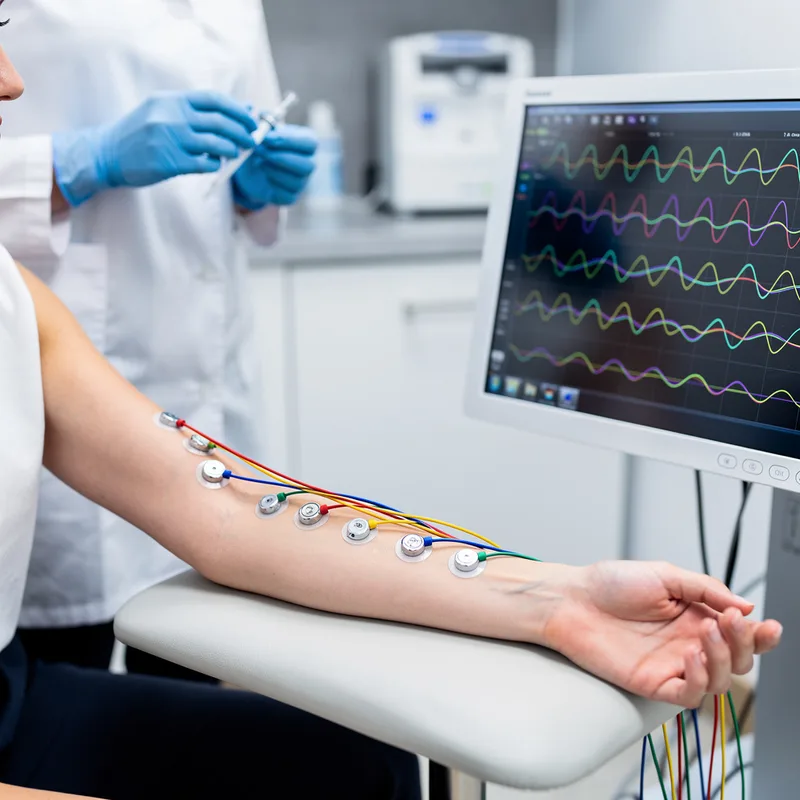
EMG
 2
6.9

- noun
- /iː ɛm dʒiː/
- Specialized
- The raw electromyographic (EMG) signals were recorded at 1,000 Hz for a period of 5 seconds for each trial.
- EMG signal
- EMG activity
- EMG - electromyograph
Examples
-
With no evidence of motor unit potentials on EMG/NCS at three months post-injury, patients were scheduled for surgery.
Academic text (2015) -
And so there's a signal in the EMG that you can detect reliably.
-
A distinct pattern of EMG activity was observed for all the seat positions.
Academic text (1992) -
Fatigue causes large errors between the EMG and muscle force estimates.
Academic text (1992) -
I was sent to a podiatrist who issued me an EMG and a series of cortisone shots.
Blog text (3) -
Preoperative electrophysiological testing (EMG/NCS) confirmed an isolated axillary nerve injury in all patients.
Academic text (2015) -
The doctor recommended an EMG to assess my muscle activity and diagnose the issue.
-
After experiencing muscle weakness, I underwent an EMG to evaluate my neuromuscular health.
-
The physiotherapist explained that the EMG would help identify any nerve damage affecting my movements.
Synonyms

 1
9.1
A test that records the electrical signals from muscles when they move
 1
8.4
A test that records the electrical activity of muscles to find nerve or muscle problems
Surface Forms
Etymology
EMG comes from the longer word electromyography, which breaks into electro- 'electric', myo- 'muscle' and -graphy 'writing'. So an EMG is like 'writing down' the electric signals a muscle makes, which helps doctors see how muscles and nerves work.