
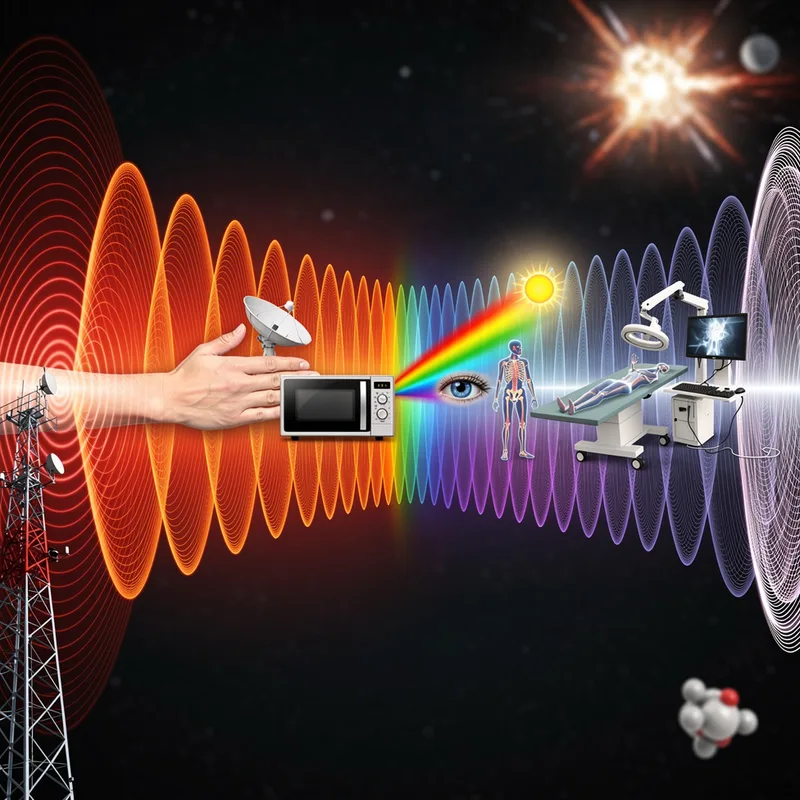
electromagnetic spectrum
 4
6.1
4
6.1

- noun
- /ˌiːlɛkˌtrɒmægˈnɛtɪk ˈspɛktrəm/
- Specialized
- The electromagnetic spectrum includes many types of radiation, from radio waves to gamma rays.
- part of the electromagnetic spectrum
- portion of the electromagnetic spectrum
- region of the electromagnetic spectrum
Loading YouTube…
Watch on YouTubeIt's a very tiny slice in the electromagnetic spectrum.
- It's a very tiny slice in the electromagnetic spectrum.
- These are entire bands of the electromagnetic spectrum, which we call light, only some of which is visible.
Examples
-
Since then, astronomers have drawn back the curtains from other parts of the electromagnetic spectrum.
Academic text (1996) -
In addition, both ground-based and Earth-orbiting telescopes have studied Jupiter's magnetosphere in many bands of the electromagnetic spectrum.
Academic text (2000) -
These are entire bands of the electromagnetic spectrum, which we call light, only some of which is visible.
-
Why is it limited to seeing such a narrow portion of the electromagnetic spectrum?
Academic text (2003) -
Outside the realm of human vision is an entire electromagnetic spectrum of wonders.
Blog text (32) -
We see a different part of the electromagnetic spectrum, the ultraviolet.
Fiction book (1998) -
Infrared (IR) light occurs just beyond visible light in the electromagnetic spectrum.
Academic text (2006) -
Remains of the 1054 supernova in the direction of Taurus look considerably different in different regions of the electromagnetic spectrum.
Academic text (2004) -
Because the jet emission is seen across the electromagnetic spectrum, the study of AGNs is most productively a multiwavelength endeavor.
Academic text (2012) -
At the ultrashort-wavelength end of the electromagnetic spectrum are high-frequency, high-energy gamma rays, whose wavelengths are measured in picometers.
Academic text (2006)
Synonyms
 46
5.4
46
5.4
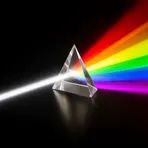
A band of colours seen in a rainbow when light splits
Surface Forms
Morphology
The meaning is directly compositional: 'electromagnetic' specifies the type of phenomena (electric and magnetic radiation) and 'spectrum' denotes a range or band, so together they denote the range of electromagnetic wavelengths/frequencies. This is a regular scientific noun–noun compound following common compositional patterns (and paralleled in many languages), so a B1 learner who knows both constituents should be able to infer the meaning.
Etymology
Electromagnetic spectrum comes from two simple images: electromagnetic because these waves come from electric and magnetic forces, and spectrum meaning a range like a rainbow. Scientists saw that light and other invisible waves form one long band from radio waves to X-rays, so the phrase means the full 'range' of these waves.