

echinococcosis
- noun
- /ˌɛkɪnəˈkɒkəsɪs/
- Specialized
- After the diagnosis of echinococcosis, the patient was referred for specialized care to manage the cysts.
- polycystic echinococcosis
- human echinococcosis
Examples
-
Echinococcus multilocularis is the causative agent of the parasitic zoonosis alveolar echinococcosis.
Academic text (2012) -
The disease may also emerge in other countries, such as the Netherlands, where polycystic echinococcosis in a human was recently diagnosed (14).
Academic text (2015) -
The blistering looks like echinococcosis.
-
Until now, the eastern part of the French territory was considered the western limit of the European echinococcosis-endemic area.
Academic text (2012) -
Third, the geographic distribution of echinococcosis has extended toward Russia and neighboring countries (10), including the Baltic states.
Academic text (2012) -
Of the 128 pacas, polycystic echinococcosis was present in 15; overall prevalence was 11.7% (95% CI 6.7-18.6%).
Academic text (2015) -
Monitoring the possible further extension of the parasite westward and southward and the evolution of prevalence in foxes in the historically and newly echinococcosis-endemic areas is also essential.
Academic text (2012) -
Our study could be the beginning of more investigations involving wild and domestic animals and humans in the Amazon to determine the incidence and prevalence of polycystic echinococcosis in human populations and the potential role of domestic dogs as carriers of adult E. vogeli cestodes (4).
Academic text (2015) -
The high prevalence of polycystic echinococcosis in pacas in this study is consistent with the paca being a common intermediate host and the possibility that human cultural and dietary habits in the Amazon region might induce a parasite life cycle that involves domestic animals, particularly dogs.
Academic text (2015) -
The doctor explained that echinococcosis can cause serious complications if not treated promptly.
Synonyms

An infection by young tapeworms that makes cysts in organs like the liver
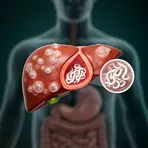
A disease caused by young tapeworms that make small pockets in organs
Surface Forms
Morphology
echinococcosis = echinococcus (transparent) = echinococcus + osis
Formed by the parasite name 'echinococcus' plus the disease-forming suffix '-osis', so the word straightforwardly denotes a disease caused by that organism.
Etymology
The word echinococcosis comes from Greek parts echino- meaning 'hedgehog' or 'sea urchin' and -coccus meaning 'berry'. The parasite was named for its round, sometimes spiny look like a small 'berry' or 'urchin', and echinococcosis is the disease that happens when these parasites make cysts in organs such as the liver or lungs.

