
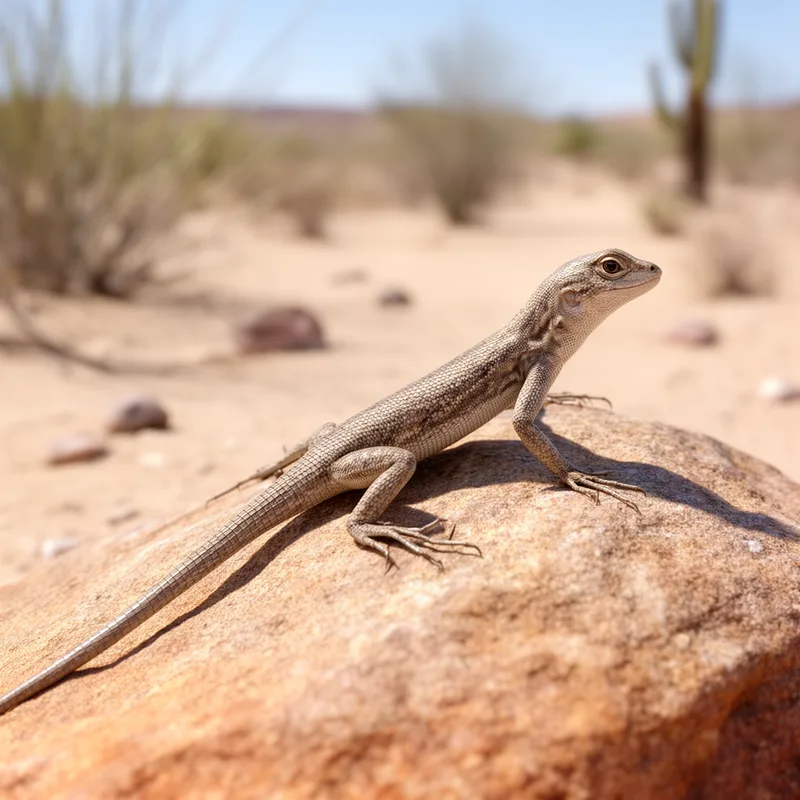
earless lizard
- noun
- /ˈɪr.ləs ˈlɪ.zərd/
- Specialized
- The earless lizard is often found in sandy areas.
Examples
-
Researchers observed several earless lizards basking on rocks in the midday sun.
-
The earless lizard is well adapted to the sandy soils of the southwestern deserts.
-
Unlike other lizards, the earless lizard lacks external ear openings.
-
I saw an earless lizard in the desert yesterday.
-
The earless lizard can often be seen basking in the sun on the warm, dry plains of the southwestern United States.
-
Biologists are studying the earless lizard to learn more about its unique adaptations to desert life.
-
Unlike many other lizards, the earless lizard lacks external ear openings, which helps it blend into its sandy environment.
Synonyms
A group of small earless lizards from North and Central America
Surface Forms
Morphology
The noun phrase is a straightforward composition of 'earless' (without visible external ears) + 'lizard' (a reptile), so its meaning—a lizard that lacks external ear openings—is directly and transparently derivable from the parts. This is a literal descriptive adjective+noun pattern common across languages, so a B1 learner who knows both constituents will readily understand it.
Etymology
Earless lizard comes from the animal's look: the words earless and lizard show it is a lizard that seems 'without visible ear openings' because it has no outside ear holes. That's why the name today means a lizard with no visible ear openings.

