
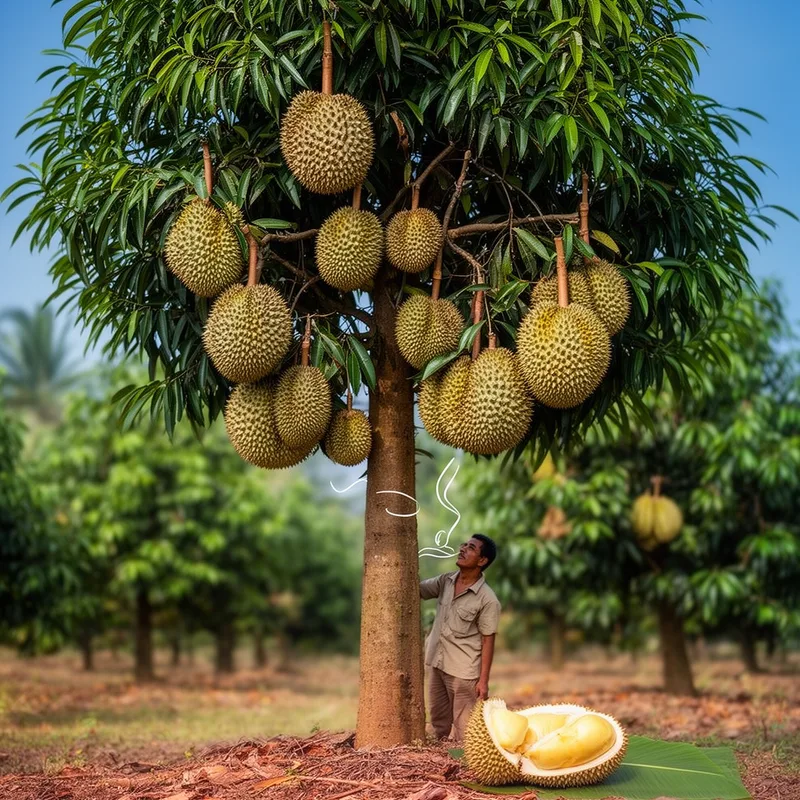
durian tree
- noun
- /ˈdʊəriən triː/
- Philippine
- A single durian tree can produce dozens of the notorious, strong-smelling fruits each year.
Examples
-
Many farmers in Southeast Asia cultivate the durian tree for its prized fruit.
-
The durian tree thrives in the tropical climates of Malaysia and Indonesia.
-
The durian tree produces unique fruits.
-
Have you ever seen a durian tree?
-
The durian tree is famous for its large, spiny fruits that have a very strong smell.
-
Farmers in Southeast Asia often cultivate durian trees to sell their distinctive fruits.
-
The durian tree thrives in tropical climates, requiring warm temperatures and high humidity.
Synonyms
A tree native to Southeast Asia that produces large spiny fruit with a strong smell called durian
A tree from Southeast Asia that grows large spiky fruit
A tree in Southeast Asia that grows oval edible fruit with a hard spiny skin
Surface Forms
Morphology
The phrase is directly compositional: a 'durian tree' is simply a tree that bears durian fruit, which follows the common noun + noun attributive pattern. This straightforward, literal combination is cross-linguistically common and would be understandable to a B1 learner who already knows both constituent words.
Etymology
The compound noun durian tree comes from the real tree that grows the well-known durian, a large, spiky fruit that gives off a very strong 'smell'. So durian tree simply means the tree that produces that 'fruit'.

