
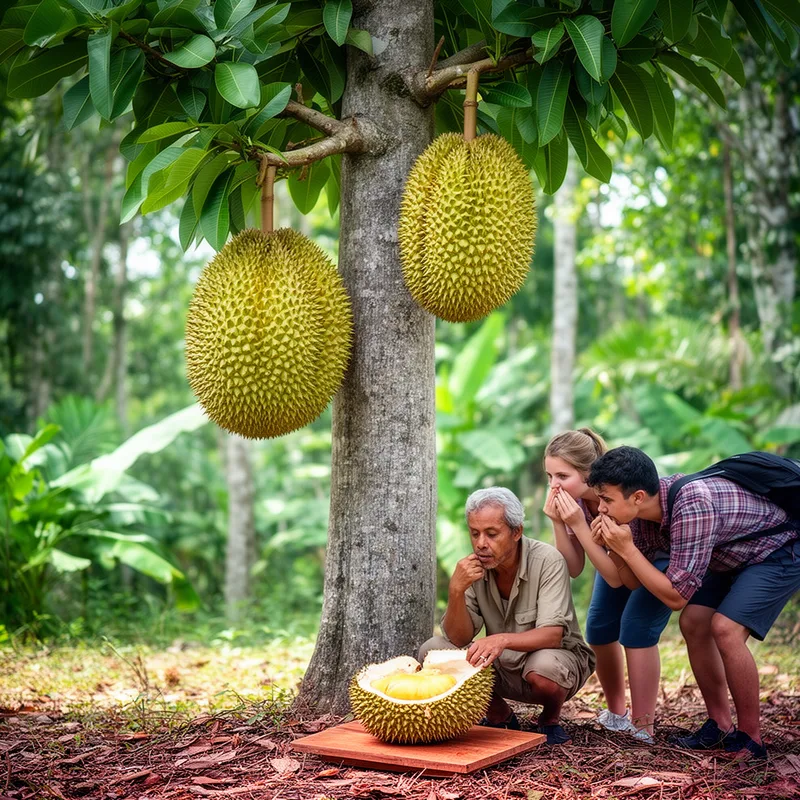
Durio zibethinus
- noun
- Specialized
- Many local farmers cultivate Durio zibethinus for its prized and pungent fruit.
Examples
-
The Durio zibethinus tree thrives in tropical climates.
-
Have you ever tasted Durio zibethinus fruit?
-
Botanists studied the growth cycle of Durio zibethinus in its native rainforest habitat.
-
The Durio zibethinus attracts tourists eager to taste the famous durian fruit.
-
Many local farmers cultivate Durio zibethinus for its prized and pungent fruit.
-
The Durio zibethinus attracts tourists eager to taste the famous durian fruit.
-
Botanists studied the growth cycle of Durio zibethinus in its native rainforest habitat.
Synonyms
A tree from Southeast Asia that grows large spiky fruit
A tree in Southeast Asia that grows oval edible fruit with a hard spiny skin
A tree from Southeast Asia that makes large spiky fruits with a strong smell
Surface Forms
Morphology
Durio + zibethinus
The genus element Durio directly signals a durian tree, so a learner who recognises 'Durio' would infer the referent is a durian species; however the species epithet 'zibethinus' has no clear lexical meaning for learners and is a Latin scientific label. Scientific binomials are partly compositional (genus + species) but rely on taxonomic convention and often uninterpretable epithets, making the overall transparency partial rather than fully predictable.
Etymology
Durio zibethinus may come from old words that point to the fruit's famous smell: the second part, zibethinus, is linked to 'zibet', a word for a musky scent. So the name helps you remember the large, spiky durian tree and its fruit, known for a very strong 'smell'.

