

to dub
 7
9.4
7
9.4

- verb
- /dʌb/
- Formal
- With great honor, I dub you Sir Galahad for your unwavering courage.
- dub someone a knight
- dub someone Sir
- I hereby dub you
Examples
-
By the power vested in me by my father, King Edward... ...and by all the witnesses here... ...I dub thee... ...Sir William.
-
I dub thee, by the sword Excalibur, Sir Mordred.
-
I shall dub you Sir Robin Hood.
-
Then I dub you Sir Bedevere, knight of the Round Table.
-
By the laws of yore, I must dub thee a man today.
-
I hereby dub thee, Sir Tow Mater.
-
No man may embark on a quest for the king without being made a knight of the order, so James of Aralon, it is with a mixture of sadness and pride that I dub thee knight.
-
I am now walking around the house giggling, imagining a Scots Order of the Holy Stove (Disestablished). "I now dub thee Knight of the Most Honorable and Puissant Order of the Holy Stove!"
Blog text (31) -
In a solemn ceremony, I dub you Sir Lancelot, protector of the realm.
-
Today, I dub you Sir Percival for your heroic deeds in battle.
Synonyms
 16
6.2
16
6.2
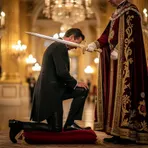
To give someone the title Sir in a formal ceremony by the monarch

To make someone a knight at a ceremony
Phrasal Verbs

Compounds



Surface Forms
Etymology
Dub meaning 'to make someone a knight' comes from an old French word adober that meant 'to equip' or 'prepare', because new knights were dressed and given a sword in the ceremony. So to dub someone is to give them the rank and title of a knight.