
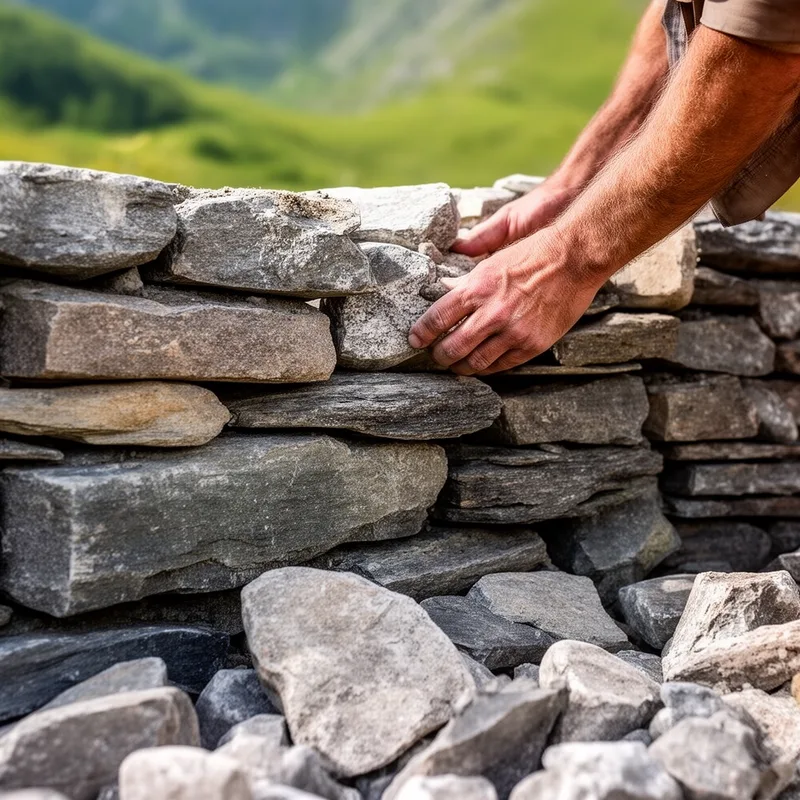
dry masonry
- noun
- Specialized
- The retaining wall, constructed of dry masonry, has stood for over a century.
Examples
-
Restorers aimed to preserve the original dry masonry in the ancient ruins.
-
Traditional mountain fences were often built using dry masonry methods.
-
The ancient castle was built using dry masonry techniques.
-
Many historical buildings feature dry masonry for durability.
-
The retaining wall, constructed of dry masonry, has stood for over a century.
-
Restorers aimed to preserve the original dry masonry in the ancient ruins.
-
Traditional mountain fences were often built using dry masonry methods.
Synonyms


 1
4.9
1
4.9
A wall made of stones fitted together without mortar
Building stone walls by fitting stones together without mortar

A style of building using very large rough stones placed together without mortar, often in ancient walls
Surface Forms
Morphology
The phrase is compositional — 'dry' modifies 'masonry', signalling a kind of masonry characterised by 'dryness' and thus not using wet mortar. However, the specific technical sense 'built without mortar' is somewhat specialized and not fully predictable from a basic B1 understanding of 'dry' (which usually means 'not wet'), so learners might grasp the general idea but miss the precise mortarless technique.
Etymology
Dry masonry comes from a simple picture: builders stack stones with no mortar, so dry means 'without mortar' and masonry means stone work. That's why dry masonry means a way of building where the stones stay up by weight and careful fitting, with 'no mortar' holding them together.