
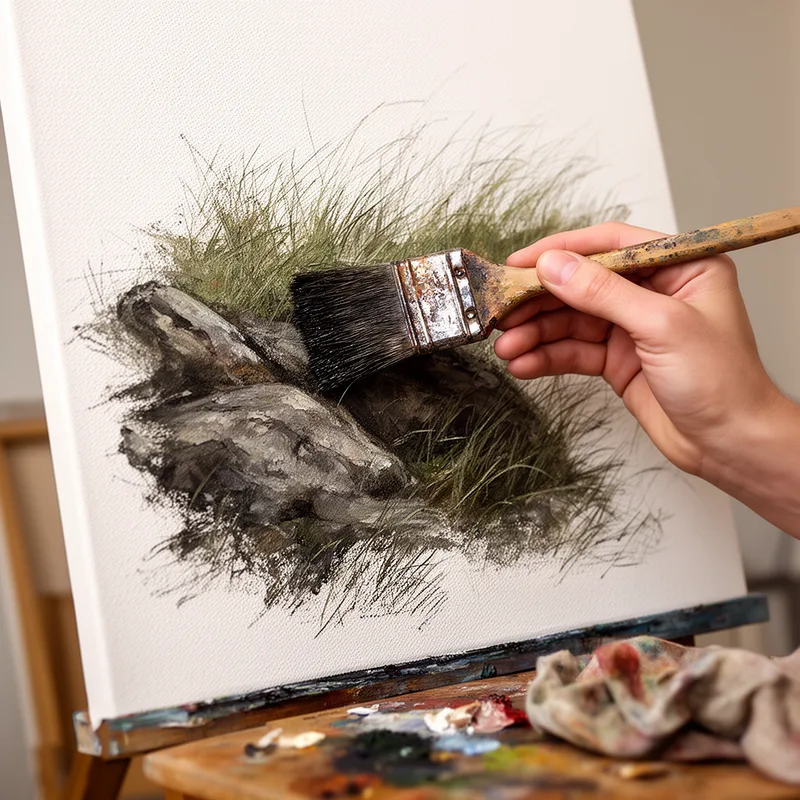
dry brush


 1
5.1
1
5.1
- noun
- /draɪ brʌʃ/
- Specialized
- Using a dry brush allowed him to create intricate details in the background of his painting.
- dry brush technique
- dry brush paint
- washes and dry brush
Examples
-
And then I like to take a clean dry brush and soften the edges of my shadow.
-
After looking at some of Lou Romano's work, I was inspired to take a more traditional-looking approach, using some dry brush painting.
Blog text (25) -
It is evident that Gornik used a very dry brush in some parts of this painting as she pulls the rain down out of the clouds.
Blog text (20) -
The artist achieved a beautiful texture by using a dry brush technique on the canvas.
-
Shannon demonstrated her skill by applying paint with a dry brush, creating a unique scratchy effect.
How Textured

Surface Forms
Morphology
The meaning is directly compositional: 'dry' (lacking moisture or much paint) combined with 'brush' (the action or tool used to apply paint) yields the sense of applying paint with a barely-wet brush to create texture. This is a literal, productively built phrase following normal adjective+verb/tool patterns, so a B1 learner who knows the relevant senses of the constituents will readily infer the meaning.
Etymology
Dry brush comes from the simple picture of using a dry brush with very little paint or water so the bristles make scratchy, uneven lines on the canvas. So the name now means the painting technique that gives a rough, textured effect.