
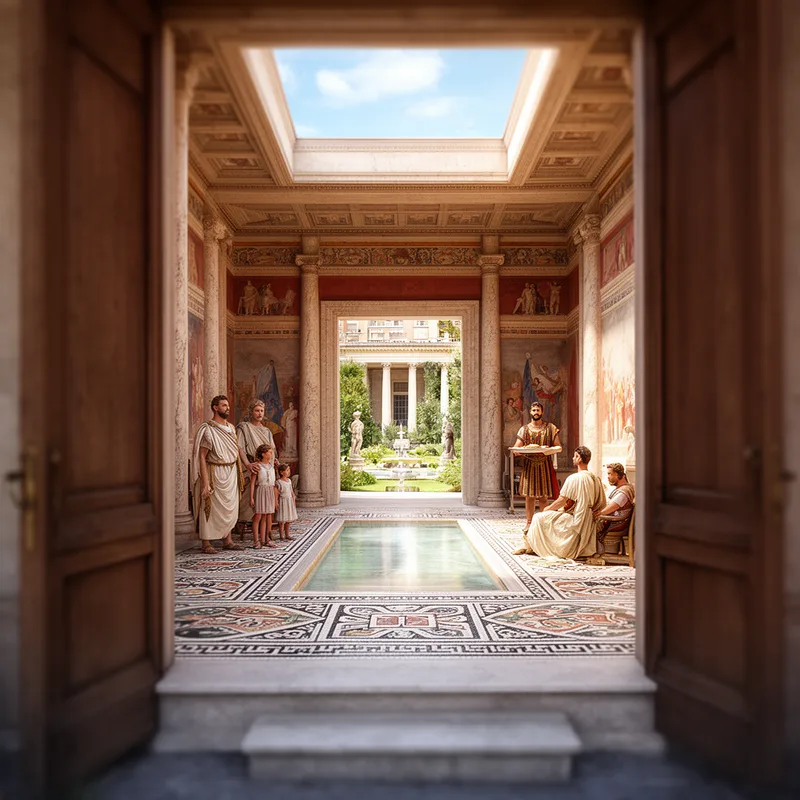
domus


 1
9.9
- noun
- /ˈdoʊməs/
- Archaic
- In ancient Rome, a domus typically featured an open atrium and a garden at the center of the house.
- Domus Valeriorum
Examples
-
In the American case, locations are almost always arbitrary, with no aura of the supernatural attending the particular parcel of real estate, so that the church is simply domus ecclesiae, the meeting place of the congregation.
Academic text (2001) -
Archaeologists have found paintings and mosaics from a previously unknown section of the Domus Valeriorum, one of ancient Rome's grandest homes.
Academic text (2006) -
This is another house that has the Domus Italica as its core.
-
But the paintings of the Domus Auria had a huge impact on Raphael.
-
Such buildings may be deemed domus dei (Turner 1979).
Academic text (2001) -
Often we think first of Roman sculpture because so much of it has survived, but thanks to the Domus Valeriorum, we now have a lot more frescoes to study.
Academic text (2006) -
Another 75 pieces of graffiti were found in the Domus of the Rose Mosaic, and the remaining graffiti came from two areas inside the city's wall and several test pits outside of it.
Academic text (2009) -
The archaeologists uncovered colorful mosaics and intricate wall paintings in the domus of a wealthy Roman family.
-
The ruins of the domus reveal much about the daily life and social status of its inhabitants.
How Big

Surface Forms
Etymology
Domus was the Latin word for 'house' in ancient Rome and often meant a rich family's home with mosaics and an open atrium. You can see the same root in English words like domestic and domicile, which are about 'home', so domus refers to the house itself.