
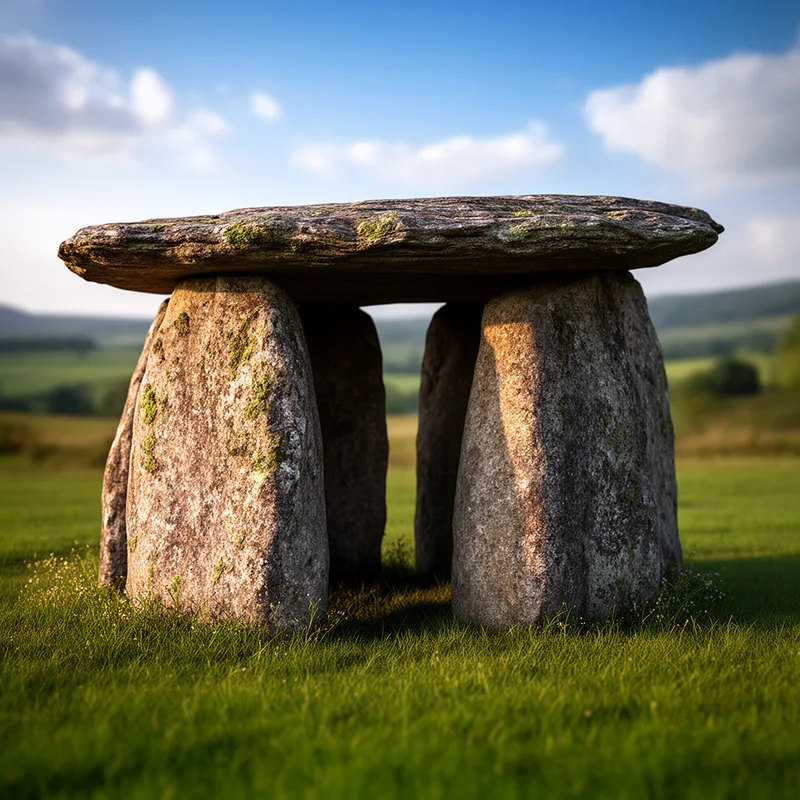
dolmen


 1
9.9
1
9.9
- noun
- /ˈdoʊlmən/
- Specialized
- Tourists often visit the famous dolmen to learn about its historical significance and construction.
Examples
-
Rollright contains all the principal structures of interest to Earth Mystery researchers: a stone circle, an isolated menhir (the "Kingstone") some fifty yards from the circle itself, and a collapsed dolmen (the "Whispering Knights").
Academic text (1990) -
The blow knocked Casimir back, and his head struck against the dolmen.
Fiction book (1992) -
The detector picked up only minimal background readings in the stone circle, at the dolmen, and at the control sites.
Academic text (1990) -
He led them to the chapel altar, a broad dolmen of cut and polished stone.
Fiction book (1992) -
The Celtic dolmens, menhirs, and alignments were all formed around a knowledge of cycles.
Academic text (2005) -
Pocked with caves, some are craggy, some rounded like dolmens.
Fiction book (2001) -
The ancient dolmen served as a tomb for the prehistoric community that built it.
-
In the valley, archaeologists discovered a dolmen made of massive stones arranged in a circle.
Synonyms
 235
3.0
235
3.0
A large stone building or underground room where people put a dead person
 1
9.2
1
9.2
A monument of very large stones that dates from long ago

A very old stone tomb with large upright stones and a flat stone on top
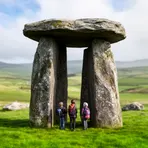
A large ancient grave made of two standing stones holding a flat stone on top
Surface Forms
Etymology
Dolmen comes from the Breton phrase taol-maen, meaning 'stone table', with taol 'table' and maen 'stone'. A helpful image is a big flat stone like a table resting on standing stones, and because many were used as tombs this name explains the structure's look and use.