
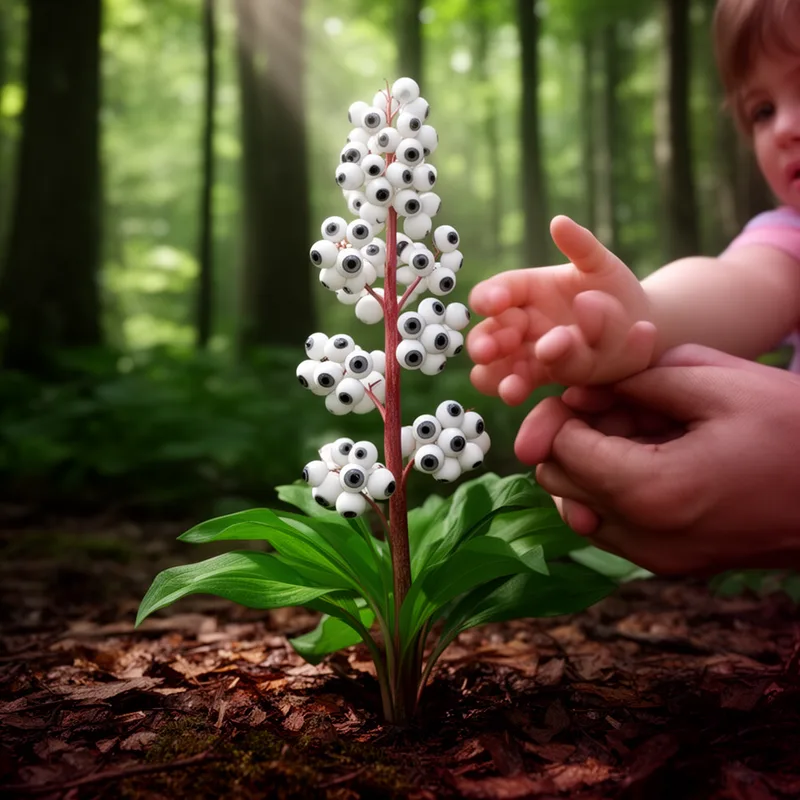
doll's eyes
- noun
- /dɑlz aɪz/
- Specialized
- The distinctive berries of doll's eyes make the plant easy to identify in the forest.
Examples
-
She warned the children not to touch the doll's eyes growing at the edge of the woods.
-
Botanists study the toxicity of plants like doll's eyes because of their danger to humans and animals.
-
The plant's doll's eyes are toxic to humans.
-
I've seen doll's eyes growing in the woods.
-
The clusters of small white berries on the doll's eyes plant can look very appealing, but they are actually poisonous.
-
She carefully explained to the children that the berries of doll's eyes should never be eaten as they are toxic.
-
While hiking, we learned to identify doll's eyes by their unique white berries, which are a sign of danger in the woods.
Synonyms

A North American plant with white, poisonous berries like small eyes
A forest plant with white poisonous berries that look like small round eyes

A North American plant with white poisonous berries that look like small balls

A plant from North America with white poisonous berries
Surface Forms
Morphology
doll's + eye
The phrase is built on a visible resemblance: a learner who knows 'doll' and 'eye' can infer that the referent looks like a doll's eyes (i.e., a descriptive, appearance-based name). However, that knowledge does not reliably tell a B1 learner that the expression denotes a specific North American herb with toxic white berries, so the full, lexicalized referent is not fully predictable from the parts alone. This partial predictability (metaphorical/labeling but not fully compositional) makes it semi-transparent.
Etymology
Doll's eyes is named for its round white berries that have a dark spot, so they look like the shiny eyes of a toy doll. That's why the name helps people spot the plant and remember its berries are 'poisonous'.

