

diurnal parallax
- noun
- /daɪˈɜrnəl ˈpærəˌlæks/
- Specialized
- Astronomers use diurnal parallax to measure the distances to nearby stars and planets.
Examples
-
The calculation of the Moon's diurnal parallax requires careful timing of observations from different locations.
-
Without considering diurnal parallax, the position of a celestial body could be miscalculated.
-
What is diurnal parallax?
-
The diurnal parallax of stars can be measured accurately.
-
Astronomers use diurnal parallax to determine how the position of stars changes from different places on Earth.
-
The calculation of the Moon's diurnal parallax is essential for accurate astronomical measurements.
-
Without accounting for diurnal parallax, astronomers might misinterpret the location of celestial objects.
Synonyms
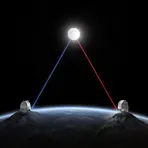
A small change in where an object in the sky looks when seen from different places on Earth
How Big


Surface Forms
Morphology
The term combines 'diurnal' (daily) with 'parallax' (apparent displacement), so the meaning — a parallax that occurs on a daily cycle — is directly derivable from the constituents. Although somewhat technical, the compositional logic is straightforward and would be understandable to a learner who already knows both words.
Etymology
The term diurnal parallax uses diurnal, meaning 'daily', and parallax, meaning a 'seeming shift'. It describes the small move a nearby star seems to make when the Earth turns and we look from different places, so astronomers use that shift to measure distance.