
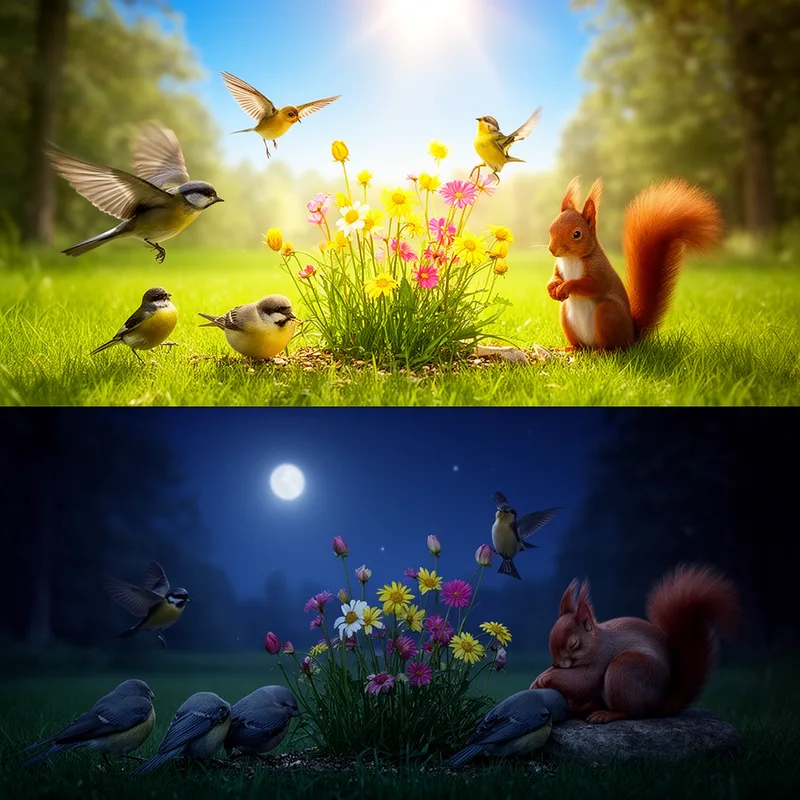
diurnal


 1
7.4
1
7.4
- adjective
- /daɪˈɜrnəl/
- We take for granted that we can only observe for a short period each day since we are born creatures of a diurnal world.
- diurnal changes
Loading YouTube…
Watch on YouTubeAnd for us diurnal species, it's time to think about sleep.
- And for us diurnal species, it's time to think about sleep.
- But we are a diurnal species by way of our genetic wiring and our neural circuit wiring.
- And also for diurnal animals which are hunter gatherers, the only time actually they have to hunt is twilight time.
- For me it would be rising, but because I'm not diurnal, I'm awake during the day.
Examples
-
The family includes some non-luminescent (and often diurnal) species that rely on pheromones to locate mates, as well as some species that merely glow rather than flash.
Academic text (2003) -
And also for diurnal animals which are hunter gatherers, the only time actually they have to hunt is twilight time.
-
And for us diurnal species, it's time to think about sleep.
-
Some are nocturnal, others diurnal.
Academic text (2006) -
And the incident is significant in another way: the vast majority of species known to mob predators are diurnal, not nocturnal.
Academic text (2010) -
We also removed all nocturnal locations from the data set because sage-grouse are active during diurnal periods and inactive at night.
Academic text (2016) -
In general, tree hyraxes live in trees and are nocturnal, while rock hyraxes live among boulders and are mainly diurnal.
Academic text (2003) -
Notice how rhythms of change—hourly, diurnal, nocturnal, seasonal—affect the place.
Academic text (2009) -
Every morning, Dazzle's dad woke with the dawn, lapped dirty water from a blocked drain, and set off for his diurnal scrounge through the neighborhood alleyways.
Fiction book (1999) -
The river otter is a mostly diurnal creature, often seen playing in the daylight.
Antonyms
Compounds


- Specialized
A small shift in a star's or planet's position when seen from different places on Earth because Earth turns
How Diurnal

Surface Forms
Etymology
Diurnal comes from the Latin diurnus, from dies meaning 'day', so it describes animals or actions that are active in daylight rather than at night.