
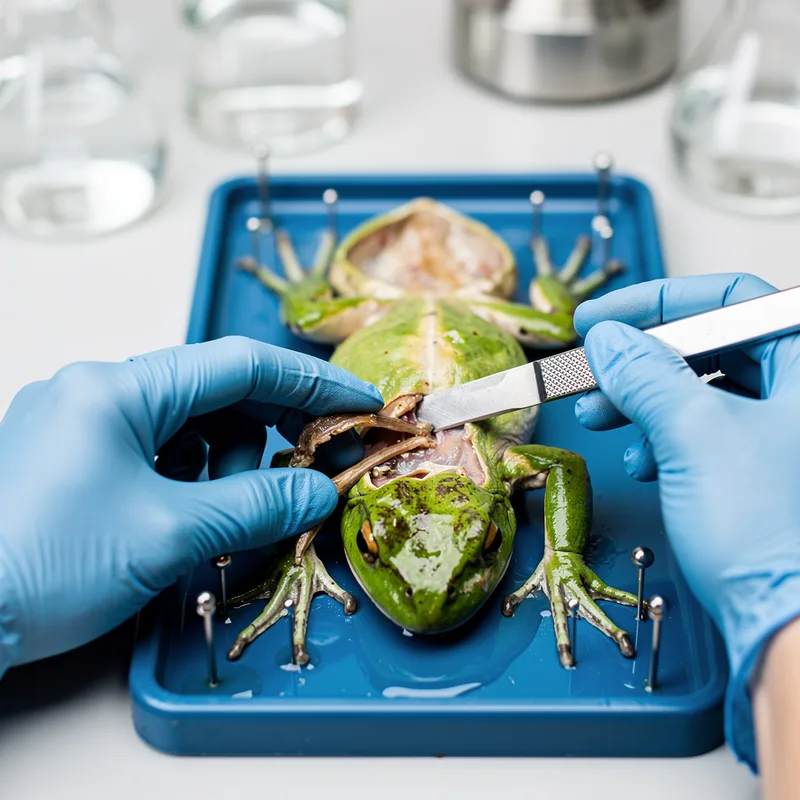
to dissect
 28
6.2
28
6.2

- verb
- /dɪˈsɛkt/
- In our biology class, we will dissect a frog to explore its internal organs.
- dissected a cadaver
- dissected a frog
- dissected the body
Loading YouTube…
Watch on YouTubeLet me see what is in your vocal chords and I will dissect your vocal chords and look in.
- Let me see what is in your vocal chords and I will dissect your vocal chords and look in.
- Alzheimer's disease is defined more or less post mortem by the by showing when you open up, you know, dissect the brain and find these plaques.
- But then after a while, he's dissecting cadavers, you know, to study the muscles and the skeleton.
- OK, If the government find out that you're a shapeshifter, they're going to hunt you down and attempt to kill you or dissect you or whatever.
- So we're the only species that will dissect our own form to be able to learn and understand what lies underneath the skin.
- Last night at dinner we we discussed some of this and you had mentioned that the you have video of an extraterrestrial being dissected.
- And yet when her brain was dissected after her death, it showed all of the hallmarks of having been ravaged by disease.
Examples
-
They wanted me to dissect a frog.
-
In regard to education, children all over the world dissect animals to learn their basic anatomy.
Academic text (2001) -
- I know how to dissect a frog.
-
So we're the only species that will dissect our own form to be able to learn and understand what lies underneath the skin.
-
I have dissected at least 30 bodies, you know?
-
The other animal, we dissected it.
-
We're ready to begin dissecting the anatomy of a frog.
-
We dissected a sheep brain at that time, so we're literally dissecting an actual brain.
-
We dissect dead frogs.
-
We'll be dissecting earthworms, frogs, and even a pig.
Synonyms
 213
2.8
213
2.8
To separate something into smaller parts to explain or study it
 7
3.4
7
3.4
To study a text or idea by looking at its parts
 1
8.8
1
8.8
To examine something carefully by looking at its parts
How Thorough
1
8.8
 28
6.2
28
6.2
Surface Forms
Morphology
dissect = section (semi-transparent) = dis + sect
The parts 'dis-' (apart) + the combining form 'sect' (cut) yield the literal meaning, but '-sect-' is a bound Latin combining form (not a standalone word), so the decomposition is only partly transparent to average learners.
Etymology
The word dissect comes from Latin parts dis- ('apart') and secare ('to cut'). So to dissect a frog or a plant is to cut it 'apart' to look at the parts inside.