

dispersity
- noun
- /dɪsˈpɜr.sɪ.ti/
- Specialized
- Researchers aim for low dispersity to produce materials with more consistent properties.
Loading YouTube…
Watch on YouTubeSo this number, and that's, I think it's called dispersity polymer.
- So this number, and that's, I think it's called dispersity polymer.
Examples
-
The dispersity of the particles affects the reaction rate.
-
A dispersity value close to 1 suggests the polymer chains are nearly all the same length.
-
The dispersity of the polymer sample was higher than expected, indicating a wide range of molecular weights.
-
Researchers measured the dispersity of the sample.
-
Dispersity is an important factor in determining the properties of a dispersity in a polymer blend.
-
The study focused on the dispersity of nanoparticles to optimize their application in drug delivery.
-
Low dispersity in a sample indicates that its particles are uniform in size and shape.
Synonyms
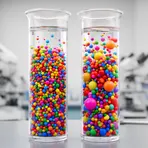
How much the particles or molecules in a sample differ in size
How Variable
- Specialized

- Specialized
Surface Forms
Morphology
Etymology
Dispersity comes from Latin parts dis- 'apart' and spargere 'to scatter', and it shares the same root as the common word disperse. So in science, dispersity is a measure of how much molecules or particles are 'scattered' in size or type — a high dispersity means the sample has many different sizes, not all the same.

