

dispersion


 1
6.4
1
6.4
- noun
- /dɪsˈpɜrʒən/
- Specialized
- Examples of this are nanostructured coatings, dispersion of nanoparticles, and bulk materials: nanostructured metals, polymers, and ceramics.
- dispersion stack
- dispersion fan
- dispersion chamber
Loading YouTube…
Watch on YouTubeThere are, I'm sure, more reasons, but that's the most important reasons why we thicken our food, the thickening process, dispersion, hydration and setting.
- There are, I'm sure, more reasons, but that's the most important reasons why we thicken our food, the thickening process, dispersion, hydration and setting.
Examples
-
Grade LP is a new heavy-duty forging lubricant that is a water-based microfine graphite dispersion.
Academic text (1998) -
EDX diffractogram (Online Resource 2) of the PyC film reveals the film composition and dispersion of constitutive elements.
Academic text (2018) -
That is a measure of dispersion, how wide that ranges.
-
In addition, there was a dispersion of course content; 35 different unit topics were identified.
Academic text (1997) -
Designs with about five times the conventional dispersion are commercially available.
Academic text (1993) -
The outlet air from the biofilter will be released to the atmosphere through the dispersion stack.
Academic text (1997) -
The mean location and dispersion of the ICRs varied depending on ankle position, ankle angle, and trim line stage.
Academic text (1997) -
Within dispersion measurements, standard deviation and variance coefficient were used for the purpose of comparing two sets of data.
Academic text (2018) -
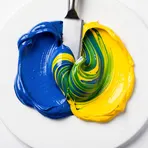
The dispersion of particles in the paint created a smooth, even finish.
-
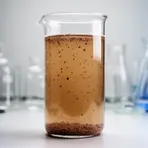
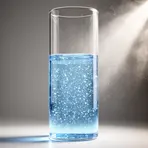
In chemistry, dispersion refers to a mixture where tiny solid particles are evenly distributed in a liquid.
Synonyms
 58
1.2
58
1.2
An action that brings two or more things together
 6
5.7
6
5.7
A mixture of tiny solid particles that float in a liquid

Different things joined together to make one thing
Compounds
How Even

Surface Forms
Morphology
Etymology
Dispersion for mixtures comes from dis- 'apart' and spergere 'to scatter', a picture like tiny bits being 'sprinkled' through a liquid. So a scientific dispersion is simply small particles 'scattered' through another substance, which is why the word is used for things like milk or paint.