
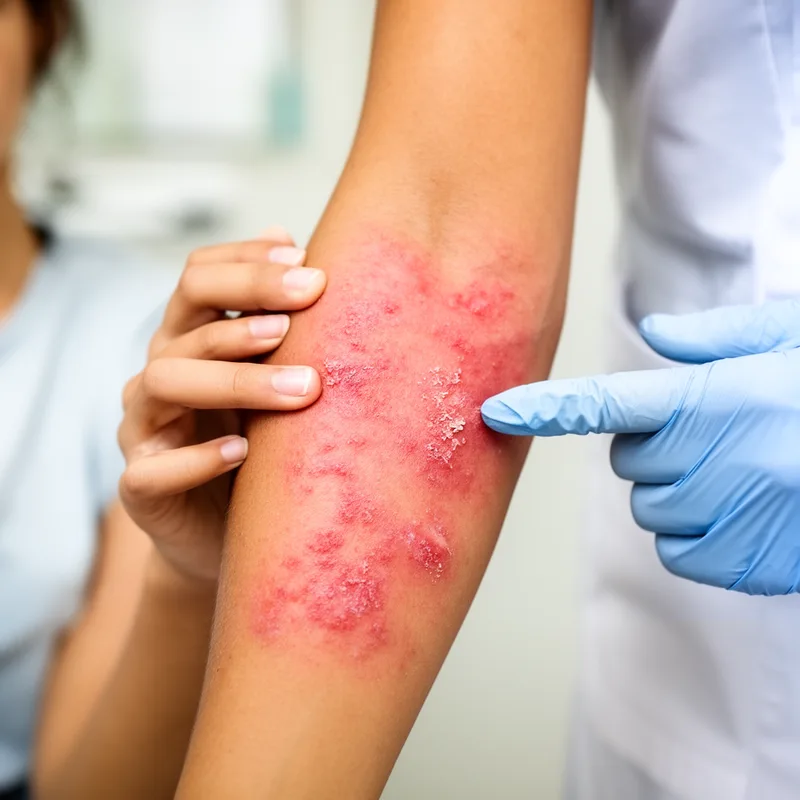
disease of the skin
- noun
- I don't fear disease of the skin or the flesh.
Examples
-
Psoriasis: Psoriasis is a common, chronic, relapsing, genetically determined, inflammatory, and proliferative disease of the skin.
Academic text (2007) -
Acne vulgaris is an inflammatory disease of the skin, affecting a large percentage of people, especially during puberty.
Academic text (2007) -
Leprosy is a progressive infectious disease of the skin.
Blog text (2) -
We are briefly reviewing the seven "vulgaris" diseases of the skin.
Academic text (2007) -
For lupus vulgaris, the disease of the skin, sunlight is known to be beneficial.
-
Acne vulgaris is a common disease of the skin that affects many teenagers during puberty.
-
Psoriasis is a chronic disease of the skin characterized by red patches and silvery scales.
-
Leprosy is a serious infectious disease of the skin that can lead to severe deformities if untreated.
Synonyms

 5
3.3
5
3.3

A problem that affects the skin, causing redness or itching
 1
3.6
1
3.6
A health problem that makes the skin red, sore, or itchy

 1
8.8
1
8.8
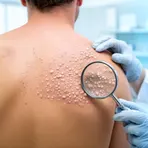
A skin disease that causes spots or bumps that are usually not red
Surface Forms
Morphology
The meaning is directly compositional: 'disease' (a medical condition) modified by 'of the skin' specifies the affected organ, so a learner who knows the constituent words and the linking structure will readily infer the overall meaning. This noun-of-noun pattern is cross-linguistically common and follows standard English grammar, making it immediately comprehensible to a B1 learner.
Etymology
Disease of the skin is a very literal phrase: think of the skin as the body's outer coat and a disease as something that damages it, like a stain or sore on that coat. So, the phrase means a 'medical problem' that affects the skin itself.