

to disarm
 93
3.9
93
3.9

- verb
- /dɪsˈɑrm/
- Do you know how to disarm the weapon?
- disarm forces
- disarm weapons
- disarm states
Loading YouTube…
Watch on YouTubeHis job was to disarm improvised explosive devices.
- His job was to disarm improvised explosive devices.
- We are absolutely together on disarming a country as a result of your fine work.
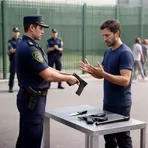
- If I'm a metre away from him, I can't disarm him.
- And Cassian's like, you know, if you trained with me, you would learn how to disarm me, but you can't.
- And so my whole thing was and is come inside the mosque, put your gun down, disarm yourself and learn.
- So when we talk about gene therapy, for us, we basically take the HIV virus and we disarm it.
- The IRA rejected the truce since they would have had to disarm, and Lloyd George now instructed General McCready to crush the Republicans in five months.
- We'd love to agree to just like both disarm, but we can't.
- They have their own homeland while our government is disarming the American people with open borders.
- And then she like quick judo chop disarms him and he doesn't get disarmed.
Examples
-
The Syrian Army did not have a pool of skilled people to disarm unexploded bombs.
Fiction book (1991) -
The renegade militias are supposed to be isolated, disarmed, arrested, and ultimately charged with crimes against humanity.
Academic text (2002) -
For both countries, their first choice was that the other country disarm while they kept their weapons.
-
We will each disarm a guard, and run.
-
"Someone has to get to that bomb and disarm it," he said.
Fiction book (2001) -
Why don't you disarm it, then?
-
In return, the PKK was expected to disarm and leave Turkish territories.
Academic text (2017) -
And before we knew what was going on, he'd already disarmed one of them.
-
Sean Archer disarmed a massive bomb just one second before it was set to blow.
-
The technician was called in to disarm the faulty bomb safely before it could detonate.
Synonyms



Antonyms

How Disarmed
- Jargon
49
6.4

- Formal
4
7.3
93
3.9
- Formal
22
6.5
87
3.5
Surface Forms
Morphology
Etymology
Disarm comes from two parts: dis- meaning 'not' and arma meaning 'weapons', the same root you see in army and armor. So to disarm someone is to take their weapons away or to make them harmless.