
diffractive


 1
9.1
- adjective
- /dɪˈfræktɪv/
- Specialized
- Overall, defect counts are already sufficiently low for structures such as high-resolution diffractive optical elements and low-resolution MEMS patterns to be printed in large numbers with sufficient reliability.
Examples
-
Software correction is just one more tool in the arsenal, and it is no more inherently objectionable than, say, aspheric or diffractive lens elements.
Blog text (14) -
This apodized diffractive intraocular lens (IOL) provides high-quality distance vision.
Blog text (31) -
And another system was proposed again a long time ago by Dyson to do this not with a prism, but with a diffractive optical structure.
-
Of these effects, diffractive intensity scintillation is the most important for SETI because the signal is modulated by 100%.
Academic text (1999) -
Diffractive intensity scintillations: intensity variations in both time and frequency, analogous to the twinkling of stars with very similar statistics, that are caused by constructive and destructive interference.
Academic text (1999) -
Although three carefully aligned beam splitters can create the desired pattern, Dwayne Miller of the University of Toronto in Canada showed last year that a micromachined diffractive optic will do the job more simply and with lower noise and greater stability.
Academic text (2005) -
19. M. T. Gale, "Diffractive Microstructures for Security Applications," IEE Conf. Publ. Lond. 342, 205-209 (1991).
Academic text (1995) -
The camera uses a diffractive lens to enhance image quality by bending light around obstacles.
-
In a diffractive optical system, light waves are spread out to create a clear image.
-
Sound waves can become diffractive when they encounter barriers, allowing us to hear around corners.
Surface Forms
Morphology
Etymology
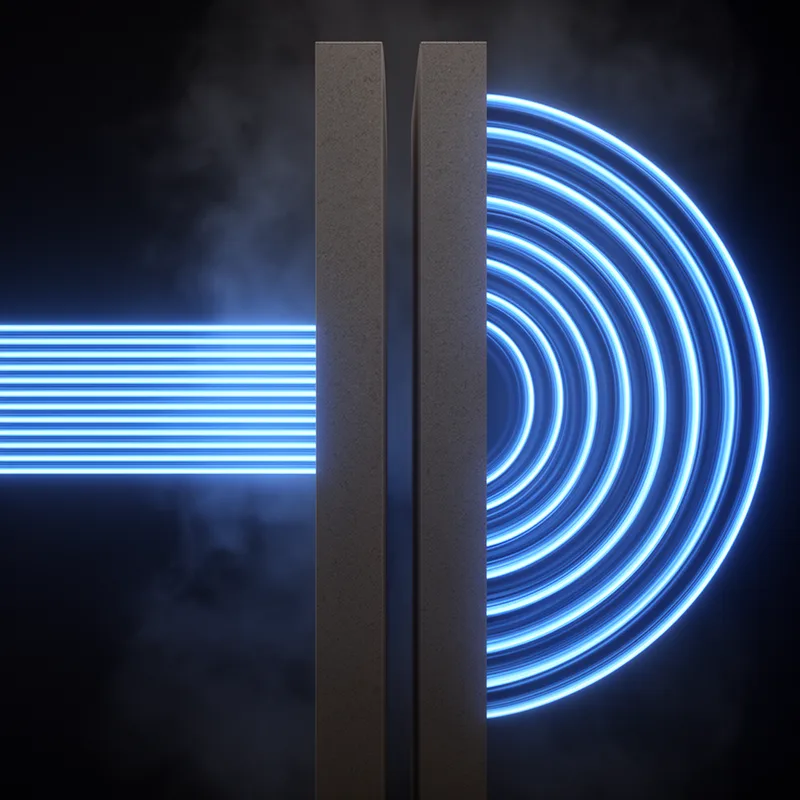
Diffractive comes from a Latin root frangere that means 'to break', the same idea behind English words like fracture and fraction. So something diffractive makes waves act as if they are 'broken' and spread into parts, like light being split into colors when it bends around an edge.