
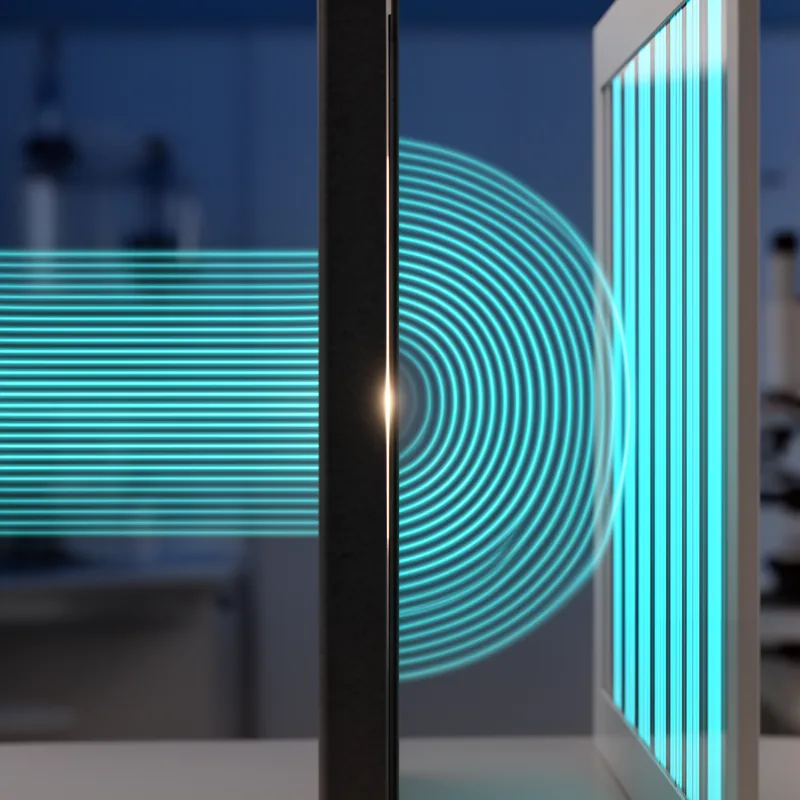
to diffract


 1
8.7
1
8.7
- verb
- /dɪˈfrækt/
- Specialized
- At NIST, another matter wave is diffracted by the grating, whereas at MIT, light is diffracted by the grating.
- light diffracted
- diffracted beam
- wave diffracted
Loading YouTube…
Watch on YouTubeWe like, you know, we go through all these things and we land the, the thing that kept on popping up towards the end was diffracted light, diffracted light, coherent light.
- We like, you know, we go through all these things and we land the, the thing that kept on popping up towards the end was diffracted light, diffracted light, coherent light.
Examples
-
When X-rays are introduced into a material, they are diffracted in a characteristic pattern based on the regular, repeating crystalline structure.
Academic text (2003) -
The photon echo emerges as the third pulse diffracts.
Academic text (2005) -
So therefore the red color is diffracted at the larger angle than the blue.
-
However, these techniques do slightly alter the phase of the light diffracted by the specimen.
Academic text (2004) -
And you collect the X-rays which have diffracted through your sample focused onto CCD, bit like at the back of your digital camera.
-
The regularity of the substrate grooves is evident from its ability to diffract white light.
Academic text (2006) -
All right, so light starts from the source, hits the aperture plane and then gets diffracted by the apertures and winds up on the image plane over here.
-
This ordering of the molecules means that when we fire X-rays at a crystal, it diffracts or scatters the beam into hundreds of intense rays.
-
When the grating is present, a laser beam passing through the modulator crystal is diffracted, essentially splitting into two output beams, called first-order and zero-order.
Academic text (1997) -
When light passes through a narrow slit, it is diffracted and creates a pattern of bright and dark fringes.
Synonyms
To move away from a straight path or normal shape, often making images look wrong

To move outward in many directions to cover a wide area
Antonyms

How Much

Surface Forms
Morphology
Etymology
Diffract comes from Latin parts meaning 'apart' (dis-) and 'break' (fract), the same root you see in fracture and fragment. Think of a wave 'breaking apart' and spreading out when it passes a small gap or edge, which explains why diffract means to bend or spread and make a pattern.