

diethylaminoethyl cellulose
- noun
- Specialized
- The lab uses diethylaminoethyl cellulose for protein separation.
Examples
-
The laboratory used diethylaminoethyl cellulose columns to separate proteins during the experiment.
-
Researchers prefer diethylaminoethyl cellulose when isolating negatively charged molecules from complex mixtures.
-
Purification of the enzyme involved a step using diethylaminoethyl cellulose for ion-exchange chromatography.
-
Researchers often prefer diethylaminoethyl cellulose in chromatography.
-
Purification of the enzyme involved a step using diethylaminoethyl cellulose for ion-exchange chromatography.
-
The laboratory used diethylaminoethyl cellulose columns to separate proteins during the experiment.
-
Researchers prefer diethylaminoethyl cellulose when isolating negatively charged molecules from complex mixtures.
Synonyms
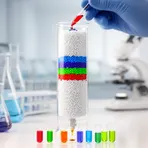
A lab material used in columns to separate charged molecules like proteins or DNA
Surface Forms
Morphology
diethylaminoethyl + cellulose
The phrase is compositionally a chemical modifier + 'cellulose', so a learner who could parse 'diethylaminoethyl' would at least infer this is a chemically modified form of cellulose. However 'diethylaminoethyl' is a technical, multi-part chemical name and the specific functional meaning (an ion-exchange resin used in chromatography) is not predictable from everyday vocabulary, so the expression is only partially transparent to B1 learners.
Etymology
Diethylaminoethyl cellulose gets its name from two parts: cellulose is a plant fiber that makes the solid base, and diethylaminoethyl is a chemical 'arm' that has a positive charge like a tiny magnet. That's why this material is used to 'catch' negatively charged molecules and help 'separate' or 'purify' them.

