
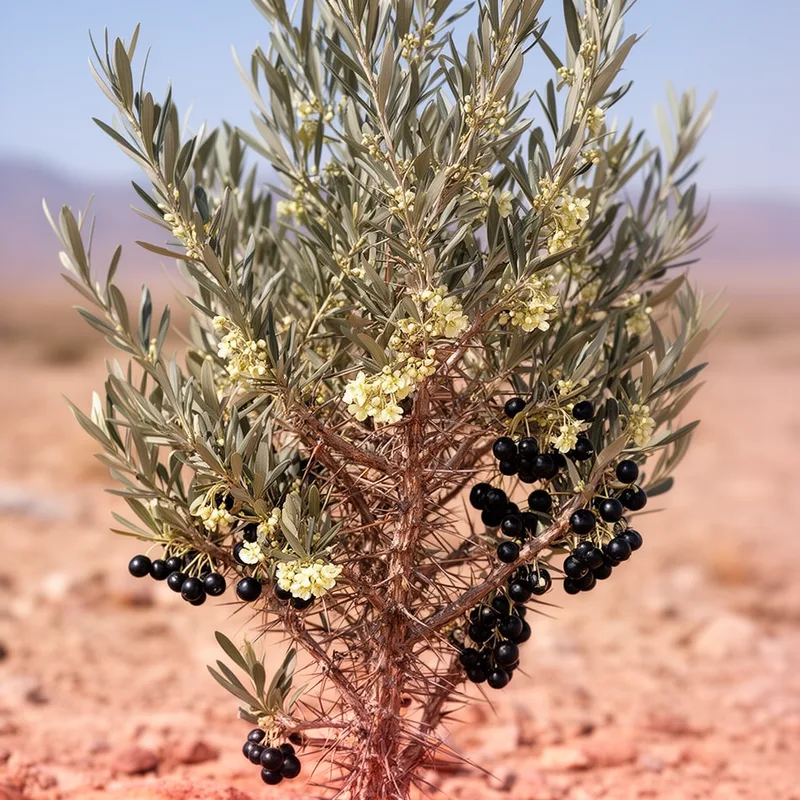
desert olive
- noun
- /ˈdɛzərt ˈɑlɪv/
- US
- The desert olive thrives in arid landscapes across the southwestern United States.
Examples
-
Clusters of black berries appear on the desert olive each summer, attracting birds.
-
Gardeners appreciate the hardy nature of the desert olive despite its unassuming flowers.
-
The desert olive thrives in arid conditions.
-
Many desert olives grow along the canyon trail.
-
Clusters of black berries appear on the desert olive each summer, attracting birds.
-
Gardeners appreciate the hardy nature of the desert olive despite its unassuming flowers.
-
The desert olive thrives in arid landscapes across the southwestern United States.
Synonyms
A spiny bush from the southwestern United States that blooms before its leaves and makes dark berries

A spiny shrub with small yellow-white flowers before its leaves and black berries
Surface Forms
Morphology
The compound is transparently compositional: 'desert' specifies the habitat and 'olive' names the kind of plant, so a learner who knows both words will infer it refers to an olive or olive-like shrub found in desert areas. Detailed botanical traits (spiny, deciduous, berry-like fruits) are not predictable from the parts, but the basic referent is directly derivable from the constituents.
Etymology
Desert olive is named for how it looks and where it grows: its small, dark, olive-like berries and narrow leaves resemble a true olive, and it lives in dry desert places. So the name helps you remember it is a tough shrub with olive-like fruit.

