
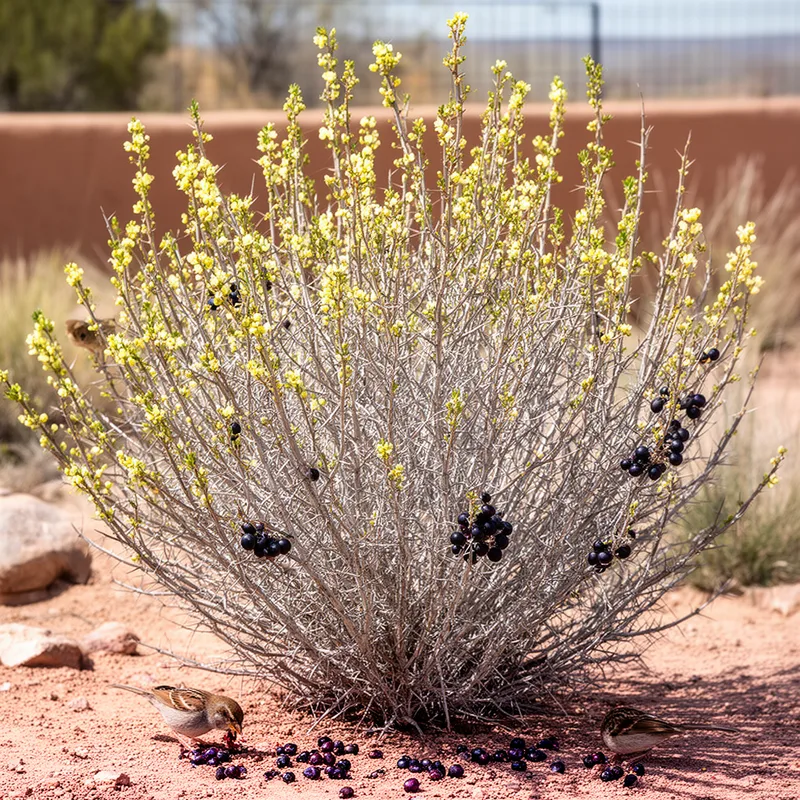
Forestiera neomexicana
- noun
- Specialized
- The Forestiera neomexicana blooms in early spring before its leaves appear, brightening the landscape.
Examples
-
Many gardeners plant Forestiera neomexicana to attract birds that feed on its dark fruit.
-
The spiny branches of Forestiera neomexicana make it an effective barrier hedge.
-
The Forestiera neomexicana blooms beautifully in early spring.
-
Have you seen a Forestiera neomexicana in bloom?
-
Many gardeners plant Forestiera neomexicana to attract birds that feed on its dark fruit.
-
The Forestiera neomexicana blooms in early spring before its leaves appear, brightening the landscape.
-
The spiny branches of Forestiera neomexicana make it an effective barrier hedge.
Synonyms
A spiny desert shrub that makes small pale flowers and black berries

A spiny shrub with small yellow-white flowers before its leaves and black berries
Surface Forms
Morphology
Forestiera + neomexicana
This is a scientific binomial: knowing 'Forestiera' as a genus of shrubs lets a learner infer it names a particular kind of shrub, so part of the meaning (that it is a plant/shrub) is transparent. However, 'neomexicana' is a Latinized species epithet (not a common English word and not in the dictionary here), so its specific sense (e.g. provenance 'of New Mexico') is not predictable for a B1 learner without botanical/Latin knowledge, making the expression only partially transparent.
Etymology
Forestiera neomexicana is a plant name that gives a simple picture: Forestiera is the plant group and neomexicana means 'from New Mexico'. This fits the shrub because it is a spiny plant that flowers before its leaves and makes dark berry-like fruit, so the name helps you remember what it is and where it grows.

